[00:00:00] Speaker A: Hi everyone. In this episode we'll discuss what you can do to prepare your organization in case it becomes the subject of a Congressional investigation. I'm your host, Bill Coffin and this is the Ethicast.
We've all seen it on the news. A high profile organization suddenly called before Congress to explain itself, sometimes for reasons that are clear and sometimes for reasons that feel more political in nature or worse, to answer for a public outcry that in reality has little to do with the daily operations of the company called to testify.
Most companies don't actively imagine what it might be like to find themselves on the receiving end of Congressional scrutiny. But for those who go through such an experience, they never forget it and it teaches them all a valuable lesson. Advanced preparation is always energy worth spending.
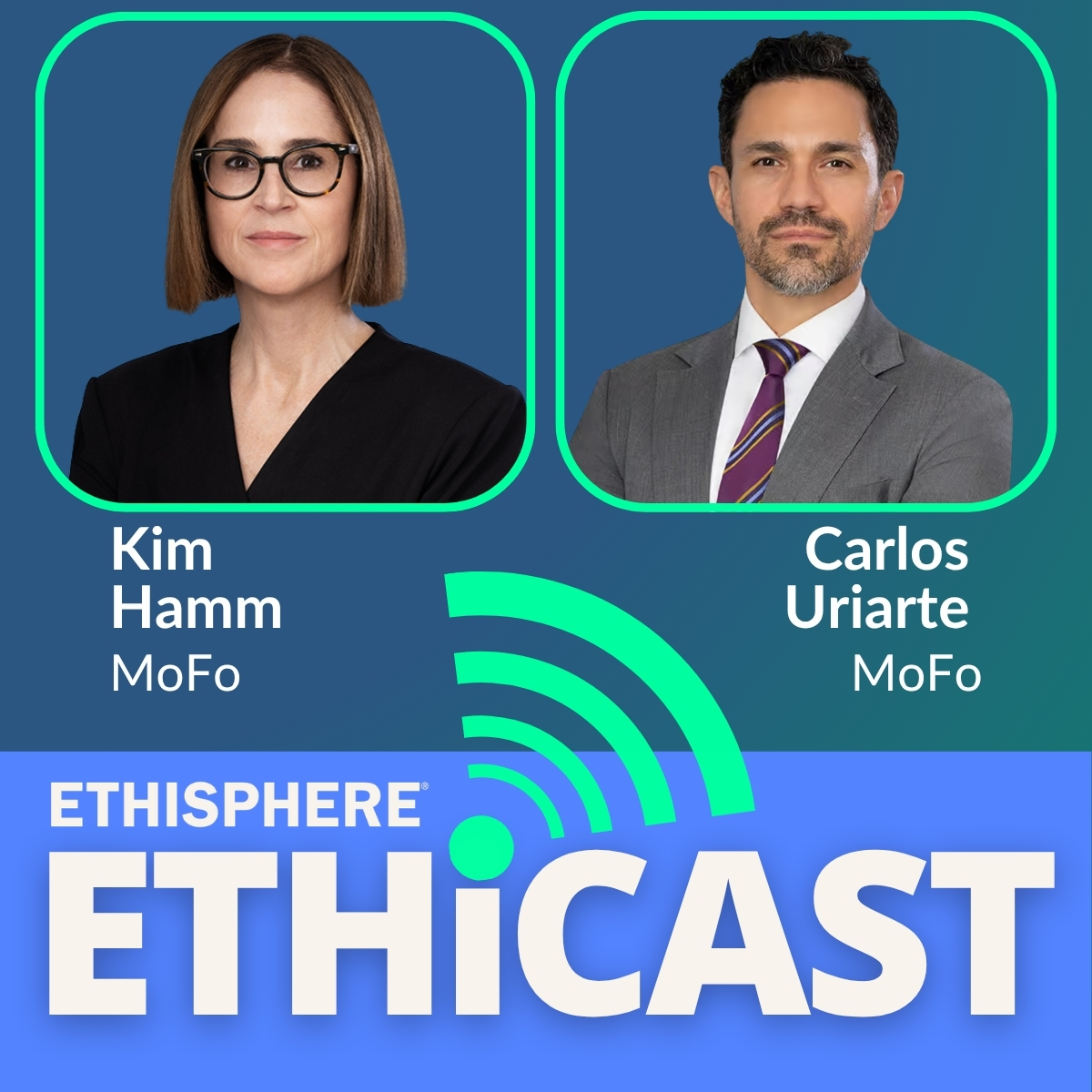
Joining us this episode are Kim Hamm and Carlos Felipe Uriarty, both of whom are partners with Morrison Forster and Based in Washington D.C.
kim is co chair of Morrison Forster's Congressional investigations and securities enforcement practices and a partner in the firm's investigations and white collar defense practice. Kim has served in senior positions in the U.S. congress and securities and Exchange Commission, providing her with the political acumen and legal judgment needed to advise clients on successfully navigating the challenges of today's increasingly polarized environment.
She has represented corporate clients in matters before multiple House and Senate committees, bringing deep insight into both the investigative process and the broader political context.
Carlos is former Assistant Attorney General for the Office of Legislative affairs at the Department of Justice and is co chair of Morrison Forster's Congressional investigations practice. He draws on his extensive experience conducting and defending against congressional investigations, working at the highest levels of the DOJ and in Congress, and serving in senior in House compliance and regulatory roles to represent clients facing complex and high stakes government investigations and enforcement actions. Kim and Carlos, welcome to the Ethicast. I'm really excited to speak with you today.
[00:02:04] Speaker B: Thank you so much for having us. I really look forward to our discussion.
[00:02:08] Speaker C: Thanks Bill. Great to be here.
[00:02:10] Speaker A: Increasingly, private sector companies and activities are the targets of congressional investigations. So my question to you is what does a Congressional investigation really entail?
[00:02:21] Speaker B: Yeah, it can be very different from other types of government investigations. And I think it's sort of important to start with that. It's not a law enforcement investigation, it's not a regulatory investigation, and it can't be handled the same way you might handle a DOJ matter or an SEC matter.
It's really important too to know that you could do everything right from a compliance and ethics perspective and still be caught up in a Congressional investigation.
But when we talk about a congressional investigation, we typically mean a formal inquiry through one of the committees in the House or the Senate. And this kind of investigation might start with a letter from the chair of a committee seeking documents or information from a company.
The reason that we focus on committee inquiries is that committees have the ability to issue and enforce subpoenas, and that can be subpoenas for documents and subpoenas for testimony.
And although investigations can be bipartisan, typically it's the chair or the majority party of the committee that controls that subpoena authority. And the minority party does not typically have the ability to block investigations or subpoenas.
There are individual members of Congress, though, that are important part of this as well. And individual members of Congress do have the ability to issue.
They do not have the ability to issue subpoenas, but they do have the ability to investigate. And some members of Congress with a higher profile have that bully pulpit that can be a really powerful tool.
So even when it's an individual member of Congress, we do think it's important to take those seriously as well.
One important aspect of a congressional investigation is that the investigative authority is not unlimited.
Courts have recognized that congressional investigations are supposed to be for a legislative purpose. And what that means is to gather information to consider new or amended legislation, for example. But in practice, that scope, that legislative purpose, is construed very broadly. And so all industries can find themselves under scrutiny at some point.
[00:04:28] Speaker A: Carlos, do investigations start with a demand for a company executive to testify at a hearing?
[00:04:33] Speaker C: Yeah. Well, the reality is it depends. You know, as Kim kind of talked about, there's a lot of different ways that congressional investigation can manifest itself. There's a lot of different ways it can start. And historically, it was the case that committees would often start with a letter requesting additional information about the issue at hand, or maybe asking for documents so that they could develop a factual record and then come back and ask for testimony from a corporate executive or potentially have a hearing on the topic. And that practice has evolved in part because committees have gotten more accustomed to doing informal interviews called transcribed interviews, which gives them an ability to collect facts and information from a company as they are going through the investigation. And frankly, oftentimes those interviews can lead to, say, additional requests to the committee or even a hearing where they want to have an executive come back or a more senior executive come before the committee and answer questions publicly about the. The substance of their investigation.
[00:05:34] Speaker A: Kim, what particular topics or trends do you see, such as AI supply chain, data privacy, and so on, that might be especially tricky areas for organizations to navigate with regards to prompting a call to appear before Congress.
[00:05:48] Speaker B: Well, it's really all of the above. Congress is focused right now on issues that the ethics and compliance teams are also focused on. And they're the issues that you mentioned, artificial intelligence, supply chain, data privacy.
For congressional investigations too. We those issues will come up across industries. Could be tech platforms, social media, pharmaceutical companies, consumer pricing, healthcare.
And so you will see it again. All types of companies can get involved in these investigations.
Congress views these issues, though, through the lens of consumer protection, but also national security.
So in the AI space, where federal regulation is elusive and there are a patchwork of state AI laws, it can sometimes be challenging for companies. Companies from a compliance perspective. But Congress is looking at online safety, protection of children, the use of AI in pricing, the impact of AI on the economy, and the national security. Concerns in that space relate to the use of foreign AI tools by companies or foreign access to advanced US Technology and tools such as semiconductors. And so I mentioned that the federal regulation remains elusive because companies find themselves in a place where they have an obligation at a state level and they might have competing interests from Congress at the federal level.
Supply chain concerns from Congress are a big issue right now.
And these can be challenging as well, because companies have to balance the need for resilience in their supply chain with the perception and the congressional perception of significant supply chain risks outside of the United States. And I said earlier that a company could do everything right from a legal and compliance standpoint and still be caught up in a congressional investigation.
AI is one of those areas where we know that to be true. And I would just say quickly, on data privacy and also cybersecurity, Congress has been active on those issues.
On cybersecurity, if there's a significant incident, Congress has a long history of investigating.
And Congress is also worried about nation state intrusions when we're thinking about cybersecurity.
So these are all especially areas where you should be regularly speaking with government affairs and an outside counsel that deals with Congress to make sure you understand what the current concerns are and to make sure you're prepared.
[00:08:21] Speaker A: Carlos, do congressional investigations happen hand in hand with other government investigations?
And how do you see this as a risk for organizations to manage?
[00:08:30] Speaker C: Yeah, well, I think what I would say is congressional investigations rarely happen in a vacuum. Right. Oftentimes they happen because there are either other legal issues that the company is facing or maybe public scrutiny because of challenges that a company is working through. You know, an example of that might be a product recall due to a safety issue related to a product. And in those instances, you're going to see not only a congressional interest, but also, you know, federal and state agencies who are going to either have regulatory requests or maybe bring litigation. You're going to see civil litigation.
Similarly, if there's a large corporate transaction that's going through, not only now are we seeing it as relatively common for the federal regulatory authorities to look at those transactions.
Congress may be interested in those transactions, but even state AGs these days are asking questions about those transactions. And the reason this is important, I think, is because each of these different fora is quite different. And as Kim mentioned earlier, congressional investigations are quite unique among them. And so making sure that you have clear strategies on how to deal with each of these different types of investigative requests, clear strategy, how to deal with communications, the public communications aspect of these requests, and that all those strategies are coordinated is really important because one of the biggest mistakes companies can make in this area is where the strategy in one area is inconsistent or incompatible with the strategy in another area, or something that is said to a regulator may be different than what a company is saying to Congress, and that can create a lot of problems that are unnecessary in addition to whatever the underlying issue may be that the company is working through.
[00:10:10] Speaker A: Kim. Ethics and compliance, Legal and government affairs sometimes occupy different silos within the organization. It seems that now is an excellent time for organizations to break down those silos as a way to prepare for potentially being called before Congress for documents or for testimony. How would you recommend companies approach that?
[00:10:28] Speaker B: Well, you're absolutely right. Congressional investigations can move really quickly. So preparing ahead of time and figuring out those silos and breaking them down is really key.
We typically suggest, as an initial step, identify the key team members. If there's a corporate crisis, who are the various players that will be part of the company's response? That's legal, that's ethics, that's compliance, privacy, government affairs, external relations, communications, all of those groups, and with congressional investigations in particular, they are public. Often mostly they're public, unlike the initiation of a DOJ or SEC matter. And so that external relations communications part is quite key as well.
Once you've identified the key members of that team, define clearly for each one the roles each group will play and establish reporting lines, decision making lines, if that's needed.
These teams should meet regularly before there's a crisis under the umbrella of the legal department for privilege.
During those meetings, we recommend that each of the groups define and rank areas of risks across their respective group, and then they share them. So, you know, an example might be ethics and compliance identified a vendor issue as low risk to the organization because it was quickly contained and there was. There were no additional problems internally.
But Government affairs might know that that vendor is the target of a congressional investigation and might know that Congress wants to go out and, you know, potentially find out who is using that vendor because they had, for example, a national security concern with it. That's a way talking early, even about things that one group might not think is important, can really help.
And then companies should consider proactive risk audits by ethics and compliance.
Government affairs can share their insight into potential areas of inquiry by Congress, which would allow an identification of these areas to audit. So if Congress is interested in certain types of supply chain risks, for example, there could be a proactive audit ahead of time to see how you would respond if Congress did come to the company.
[00:12:51] Speaker A: Carlos, if an organization does become the target of a congressional investigation, what should they realistically expect in terms of the experience and most of all in terms of an outcome like, is there really a way to win before Congress?
[00:13:04] Speaker C: Yeah, it's a great question, Bill. And you know, I think this goes back to one of the points we've been making throughout, which is that a congressional investigation is very different than other investigations or even other legal engagements that a company may engage in. You know, there are. Is rarely a clear outcome of a congressional investigation, and oftentimes the. The best outcome is that the congressional investigation kind of quietly goes away.
And so I think it's important early on in these engagements when dealing with corporate leadership to talk about setting expectations and defining what success looks like. And that is different for every single company in every single investigation. Sometimes the priority for a company is to minimize the number of executives, maybe that go up for interviews.
Maybe there's an opportunity that they want to take to tell their side of the story about something that happened. You know, maybe they think that there's an opportunity to share certain information with Congress that will help correct the record. But all of those things are very client specific, and it really depends on, you know, what the client's business objectives are, you know, what the underlying story is and what the client sees as the sort of path out of the crisis, whatever the focus of the investigation may be.
And oftentimes one of the things that comes up in this context is a congressional hearing and whether or not the company should send a corporate executive to go to a hearing. And what does success look like when that corporate executive does attend such a hearing, I can tell you, as someone who's testified multiple times in front of Congress, that it can often be a fool's errand to try to win. In that context, the deck is actually really stacked against the witness. The members have a lot of power to run the hearing in the way that they see fit and to make the points and take the time and the way that they see fit. And so, again, it's important to think about what does success look like in that context. You know, it may be that the best outcome is to have, you know, minimize the media interest of the hearing as a way to again, help this issue go away. Because at the end of the day, you don't see headlines in the news saying corporate Executive X did such a great job at the hearing. Right.
You see the ways in which they have, you know, inadvertently said something that was inappropriate or misguided or it can maybe be taken out of context. Right. And so, again, I think it's really important to work with the client to set those expectations, not just, again, related to congressional testimony, but really holistically across across the Congressional Investigations Engagement.
[00:15:51] Speaker A: Kim and Carlos, thank you so much for joining us today to talk about this topic and offering your insights on how organizations can prepare in advance for Congressional investigations. This was a fascinating conversation. Thanks again.
[00:16:02] Speaker B: Thank you, Bill.
Thanks for inviting us. We really had a great time.
[00:16:06] Speaker C: Thanks, Bill. Really appreciate it.
[00:16:08] Speaker A: For more insights from both Kim and Carlos, visit their profile pages on mofo.com as well as their Congressional Investigations page. There you'll find plenty of terrific content, including their Client Alert. Congressional Investigations quarterly. The Q1 2026 issue just dropped, so be sure to check it out. It's outstanding reading. And for plenty of additional free resources on regulatory compliance, visit the Ethisphere resource
[email protected] resources.
Thanks for joining us. We hope you've enjoyed the show. For new episodes each week, be sure to subscribe to us on YouTube, Apple Podcasts and Spotify. And if you haven't already, please follow Ethisphere on LinkedIn to learn more about how we help organizations measure and improve their ethics and compliance programs. Together, we can make the world a better place by advancing business integrity. That's all for now, but until next time, remember, strong ethics is good business.