Episode Transcript
[00:00:00] Speaker A: Hi everyone. In this episode, we'll discuss some practical tips for how you can integrate AI into your E and C program. I'm your host, Bill Coffin, and this is the Ethicast.
The ongoing AI transformation of ethics and compliance is probably the single most disruptive influence on this profession since its inception.
Over the last 24 months, we have gone from informed curiosity to hastily creating AI governance frameworks to incorporating AI solutions into daily ethics and compliance operations.
And yet that implementation story has been deeply uneven with many organizations at various stages of their AI journey as they experiment, implement and begin to develop their own best practices.
ENC programs that have yet to make regular use of AI or that have only made slow progress in their implementation strategy are already feeling the pressure of being left behind.
Thankfully, though, there's plenty of opportunity to make up for lost ground.
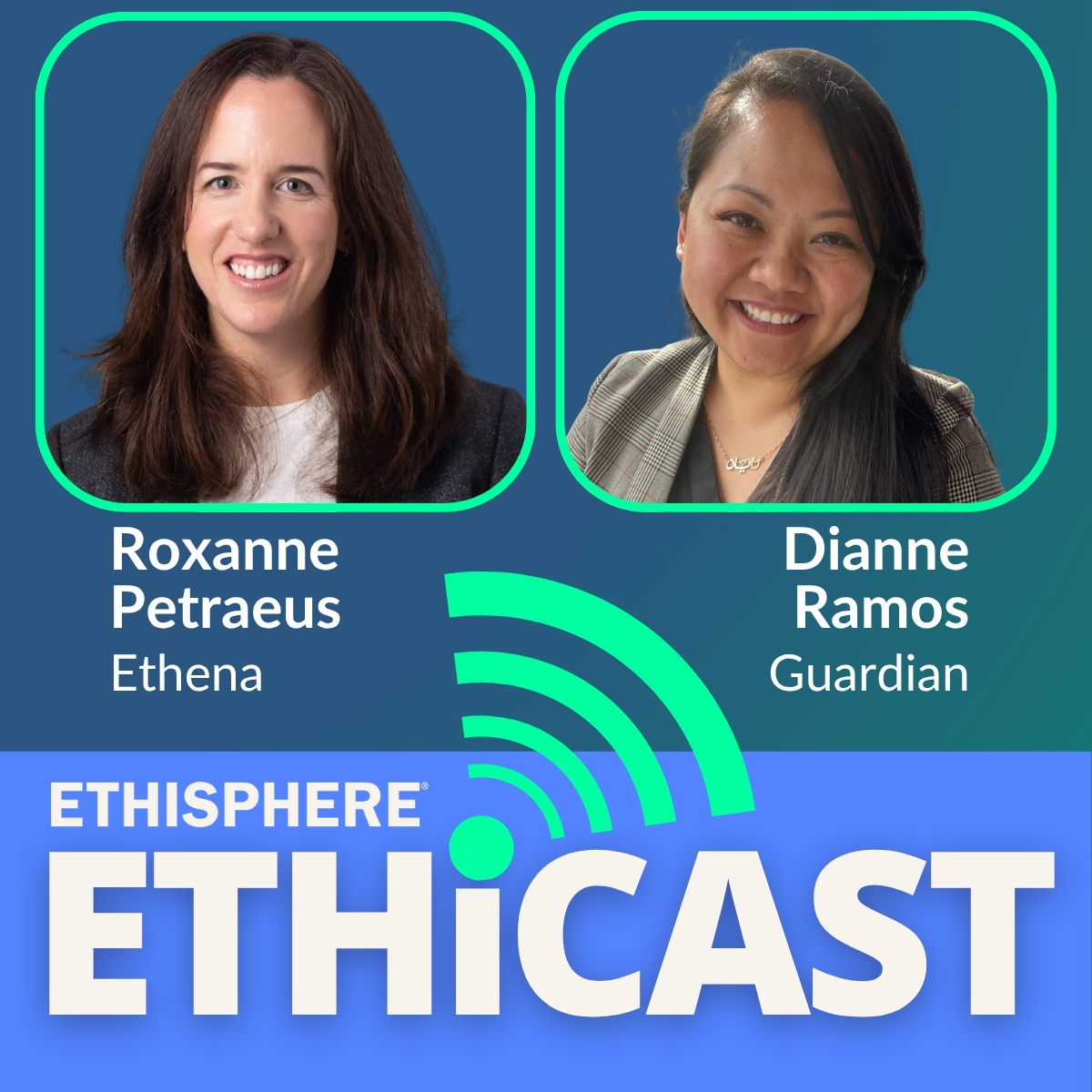
Joining us this episode to talk about implementing AI into your ENC program are Roxanne Petraeus and Diane Ramos.
Roxanne is the co founder and CEO of Athena, a leading provider of AI driven compliance program tools including specialized learning management systems, anonymous reporting tools, and more. Roxanne holds degrees from Harvard and Oxford Universities, is a Rhodes Scholar, and is a US Combat veteran having served in Afghanistan. A prolific speaker and presenter, Roxanne is one of the most visible thought leaders in the ethics and compliance space.
Diane is Head of Ethics at Guardian Life Insurance, a 165-plus-year-old Mutual Life Insurance company based in Manhattan. Guardian Life offers a wide range of insurance products and services, including life insurance, disability income insurance, annuities investments, and dental and vision insurance coverage. Roxanne and Diane recently spoke at the 2026 Global Ethics Summit where they led the superstar breakout session Prompt to Practice, a Hands on workshop for the AI Curious cco. Roxine and Diane, welcome to the Ethicast. It's an honor to speak with you both today.
[00:02:10] Speaker B: Thank you.
[00:02:11] Speaker C: Good to be here, pal.
[00:02:13] Speaker A: A lot of organizations that are behind on AI implementation may not feel like they have the luxury of spending three years to operationalize AI in their program, but what are some ways that you might recommend fast adoption of AI for those teams that feel like they need to catch up? Dan, would you like to start?
[00:02:29] Speaker C: Sure. So I would say just start and start now. It doesn't matter how you start or what you start with, just as long as you start. The objective is to build AI fluency in your team or organization, to learn fast, and to signal that responsible adoption is a leadership priority.
I recently watched a masterclass with Nicole Bradford where she said that if people haven't used AI, then they can't even imagine what it can do and they can't imagine what it cannot do. So if they don't know what it can't do, then they're very afraid of it. And if they don't know what it can do, then they're not really inspired to use it.
So I would call myself an SME in this area. A subject matter matter experimenter, not a subject matter expert. I treat this as a discipline. So blocking time every day to play with AI, you know, not needing to have the deepest technical expertise, just the curiosity to learn and to create a safe space for yourself to experiment. But just start now. Wherever you are, start with AI.
[00:03:36] Speaker A: Roxanne, your thoughts?
[00:03:38] Speaker B: This is sort of, it's like being a child. You just need to do stuff in order to learn it. There's no real kind of like pure classroom academic way to, to, to learn AI. I completely understand that can be very overwhelming. And so I think one thing that we are working a lot with our customers on is we're a vendor, but we really want to be a partner as well in, in explaining where I can be used. So I spent about half my day on calls with customers learning about their problem, showing them how they can use AI tools, whether it's a feedback really heavily in particular in compliance training or just other tools that I have found to be particularly useful. So I think finding that community that is sort of working on similar problems is also really helpful because a lot of insight just comes from, oh, I tried this thing this morning and it works perfectly.
[00:04:29] Speaker C: Finding a group of people to share learning is really powerful.
[00:04:33] Speaker A: So as a follow up question I'd like to ask you both.
You know, organizations often are, they're, they're sometimes, sometimes they're in a place where they're tinkering, sometimes they're a place they have tools that are kind of more ready for prom prime time as they are finding their way through that. I imagine there's always a matter of, you know, especially as you experiment, there's a matter of wasted work or there's a matter of you're spending time, you're not having an immediate, you know, return for that. Can you talk about how do you accept a certain degree of early wasted work as a, as a cost of skilling up?
[00:05:03] Speaker B: I'm happy to go first. I wasted a bunch of hours this week doing silly little things that didn't, didn't pay off.
I think that Dan's framework of like you just have to get hands on. There's no way to learn.
I teach my son piano. He makes a bunch of key mistakes. Right. That's like how you learn is you. You make mistakes. And so I think AI is like, not terribly different in that if you're going in expecting that each thing you stand up is going to work perfectly, there's going to be no bugs, and it's going to save you time, you'll be very frustrated. But that would be true of learning any skill. Like, part of the stumbling is it's just like, baked into learning.
And so I think that, you know, that is, like, probably just a mindset shift, but then if you layer on that, again, a community of people who can kind of help you. Even internally at Athena, we have a Slack channel just dedicated to AI learnings. And if I run into a particular hill that I just can't seem to get over, you know, I like, post about it in there and say, has anyone else run into this? So I think that, you know, not to be a broken record, but I think that finding a community of folks who are going through it similarly can help in those moments of I'm stumbling, but you will absolutely stumble.
[00:06:16] Speaker C: Yeah. Just to add on, I can agree more, Roxanne. I think, in fact, I wouldn't call it wasted work. That's all learning capital, and that's all really important to sort of build into the repertoire. At Guardian, we've got values to sort of identify and to guide the behaviors and how we accomplish our work, not just what we accomplish. And one of them is about learning and failing fast, but getting up and moving forward.
So I think that is really paramount to the amount of change that we're just experiencing now. And framing it as lessons learned rather than wasted effort, I think is going to be another one of those behavioral and cultural leadership mind shifts that will help you bring your organization along as you all transform in this journey.
[00:07:01] Speaker A: What are some good ways to introduce the concept of operationalizing AI within your organization, even if the environment isn't 100% ready for it?
[00:07:10] Speaker C: So I think it really has to start with a clear leadership narrative. The outcomes that we're driving or the operating model that we're changing, the principles that we won't compromise.
That's actually where AI could be a good thought partner for you and a brainstorming, sparring kind of partner.
So once you get that clear leadership narrative, from there, you move on to getting the right stakeholder alignment. So I come from a highly regulated insurance industry getting the right stakeholders, which for me includes compliance, legal risk, privacy, Security, all of that, Those are all really important partners to make sure that the concepts that we're thinking through can go through all the right review and approval frameworks. So once we look into all of that technology, data model, risk management frameworks that exist in the organization, it can feel like it's the whole village pushing forward the future that you are envisioning while doing it through the constraints of whatever might be the regulatory rules you have to follow.
[00:08:11] Speaker B: There are a bunch of different ways to get AI into your compliance program. And one of them can actually just be something you're doing today, but that you can now do in an AI native way.
And so we have a lot of customers who use us for training and what was historically maybe something that wasn't AI, right, Training that's content now actually there is an AI native way to do it. So from Athena's perspective, what that looks like is training that can respond in real time to your risks. You can prompt training. Diane had this great framework at ges about having customers who can, instead of being a creator, be an editor. Right, right. So you can be reviewing and giving feedback versus doing the heavy lifting of redlining, which was really a pre AI sort of way you, you made training. And so I think a clever way to, to bring AI in is one to, you know, think from a blue sky, if I could do anything, what would I want to do? But then also what are the very programs that I'm running today and is there a way to do them in this AI native way? And like I think that often you find kind of clever, clever ways to do it that with that approach.
[00:09:18] Speaker A: Diane, how important is it for programs to measure the impact that their AI use is having in operations? And what recommendations do you have for measurement in general?
[00:09:28] Speaker C: So measurement is one of those non negotiables. If you can't quantify impact, then you won't earn confidence, you can't secure industrial investment, you probably won't be able to responsibly scale.
So measurement is what gives you that credibility and it helps you identify what's working. It provides foundation for scaling for future successful initiatives. So strong metrics really do separate promising demos from operational value.
And the best advice that I would give is if you're early in, you're actually in the best position to measure before you change anything. And that's something I wish that I would have done a lot earlier and much more regimented fashion. Whether it's high motion studies, cycle time, error rates, costs, headcount, even rework, measure all that now then you have something to compare to post implementation and then you can decide and use those learnings to decide what to scale.
[00:10:27] Speaker A: Roxanne, as Diane was giving her answer, I saw a knowing smile from you. So clearly she was talking about things that you're familiar with. What are your thoughts on the measurement piece of all this?
[00:10:35] Speaker B: With AI, I generally think about ROI metrics in two buckets.
One is kind of time savings. That's a pretty obvious easy one. To Giant's point, you could ask how long did it take me to get my code of conduct training right. Pre AI, okay, post AI, what am I doing? But I think AI also introduces the ability to do new things that you just wouldn't have been able to do before.
And using just a pure like time saving ROI won't quite work there. So, so examples I'm seeing a lot of our customers have ideally wanted role and risk based training, but it was just hard enough to get the sort of enterprise wide training out to everybody once a year, let alone have training for their high risk orgs, their high risk geographies, or even very specific like training ahead of a big event or something like that. It's like that's too hard. AI has made it where now they actually can pretty quickly spin up training that's perfect for the sales team and make a slightly different version for the engineering team.
And so you know, that won't be saving them time. It's actually this new thing they're doing, but it's enabling more sophisticated compliance programs. So those are the two ways that I typically think about it as time savings and then almost like enablement.
[00:11:48] Speaker C: And if I can just add to that, Roxanne, like enablement at scale. Right. If you think about testing rudimentary sort of, or maybe old fashioned, not rendering compliance risk assessments, you may have used resources to test a sample group and then moved on because you have 40 other tasks that you have to do also all on a sample base. AI and the ability of that to then integrate data automate and really do it for everything puts you in this new bucket of assurance and monitoring rather than just testing.
[00:12:22] Speaker A: Diane, when you were talking about measurement before, you mentioned, you know, you kind of wish you knew that at the beginning.
Very curious to know, you know, now that you've had some experience in experimenting with AI and implementing it within your own program.
Are there any other things that you kind of wish you had known at the start of your AI implementation journey that you've, you've come to understand now?
[00:12:41] Speaker C: Yeah, so definitely I Wish that it would have been more deliberate upfront with the fighting and measuring roi so that we could objectively quantify progress and valued creation right from day one.
But as I thought more about the journey, the one most important lesson I would say that has been less technology related, has really been more about people and culture. So by nature, I would call myself a transformation oriented leader. I move fast, I'm comfortable with change, and once I clarity on strategy and destination, I'm all in. I'm fully in. I'm starting to build momentum, and I tend to build that momentum pretty quickly.
And what I had to be reminded of, and it was actually a reminder that required real courage from a team member of mine, is that not everyone experiences change at the same pace, even when they're supportive of the direction or the destination we're going to. So that was a really humbling moment for me because I realized that when leaders push too far ahead, even with good intention, we can unintentionally create distance. And that distance may just show up later as fatigue, disengagement, or people quietly opting out or worse, bending rules, succumbing to pressure in order to reach objectives.
So I really learned that leading change isn't just about setting that speed or getting to the desired outcome. It's about staying in sight of the people that you're asking to come with you. Because momentum that isn't sustainable is ultimately not progress. And that perspective really changed how I think about leadership, especially during this time.
My job isn't just to envision the future, but to make sure that the organization has the capacity, the confidence and the trust to get there together.
[00:14:35] Speaker A: Roxanne, any insights you'd like to add?
[00:14:38] Speaker B: I was smiling because I am similarly all gas, no breaks, bulldozer. And I think it has great charm. But not everyone agrees. So I completely resonate with that. And I think one mistake I made a bit early when Athena realized that we needed to kind of fundamentally rebuild the product for the AI era is sometimes it can be easier to articulate what happens if you get it wrong versus what happens if you get it right. And I think AI can feel very scary. And so often the narrative sort of kind of goes to a little bit more of a downside versus articulating this, like, exciting upside and exciting potential. So I found this about a year and a half ago or so that really we started to hit our stride when we were able to articulate, okay, but if we like nail this, what would that look like and what will that enable? Enable and let's have everyone like dream with us and I think that mindset really is important in driving what is fundamentally a huge change.
[00:15:38] Speaker A: Well, Roxanne and Diane, thank you very, very much for joining us today and for sharing your practical insights on how E and C teams can make use of AI in their daily operations. Really appreciate you having you on the show.
[00:15:49] Speaker C: Thank you. Thanks so much.
[00:15:51] Speaker A: To learn more about how Athena's AI driven learning management system, anonymous reporting and compliance tools can help transform your ethics and compliance program, please visit goathena.com that's G-O E T H E N A.com and while you're there, check out Athena's Resource center for the latest news and resources for HR learning and development and ethics and compliance leaders.
And to learn about the great work that Diane and her team are accomplishing at Guardian Life, please visit guardianlife.com to learn more about Guardian's compliance team, its code of conduct, and its corporate social responsibility efforts. And also be sure to follow both Roxanne and Diane on LinkedIn to learn about how AI is transforming the state of the art in ethics and compliance. Visit ethisphere.com to get your free copy of our report AI in Ethics and Risk to Manage Tool to Leverage, which features an overview of AI regulatory trends, AI governance best practices, and compelling use cases from ENC leaders in the field.
Thanks for joining us. We we hope you've enjoyed the show. For new episodes each week, be sure to subscribe to us on YouTube, Apple Podcasts and Spotify. Also, if you have not already, please follow Ethisphere on LinkedIn to learn more about how we help organizations measure and improve their ethics and compliance programs. Together, we can make the world a better place by advancing business integrity. That's all for now, but until next time, remember, strong ethics is good business.
It.