Episode Transcript
[00:00:00] Speaker A: Hi everyone. Today we'll look at some of the best practices that have earned FedEx the compliance leader Verification recognition from Ethisphere. I'm your host, Bill Coffin, and this is the Ethicast.
FedEx is a global leader in shipping, transportation, e commerce and digital supply chain services.
FedEx consistently ranks among the world's most admired and trusted employers, with a global workforce of more than 500,000 team members and a focus on safety, the highest ethical and professional standards, and the needs of their customers and communities.
For this podcast, we're going to focus on that ethics piece which recently earned FedEx the coveted compliance leader verification for 2025, 2026 and 2027. For Metisphere, FedEx has built a mature corporate integrity and compliance function that continues to evolve alongside significant business transformation and an increasingly complex regulatory and business environment.
At the sphere's review, team was particularly impressed by the depth and authenticity of FedEx's integrity culture, a legacy that traces back to the company's founder. Today, FedEx's leadership carries that ethos forward deliberately and visibly through their words, but more importantly, their actions.
The consistency through which leaders expressed and demonstrated this ethos is made all the more impressive given the company's scale and operational breadth.
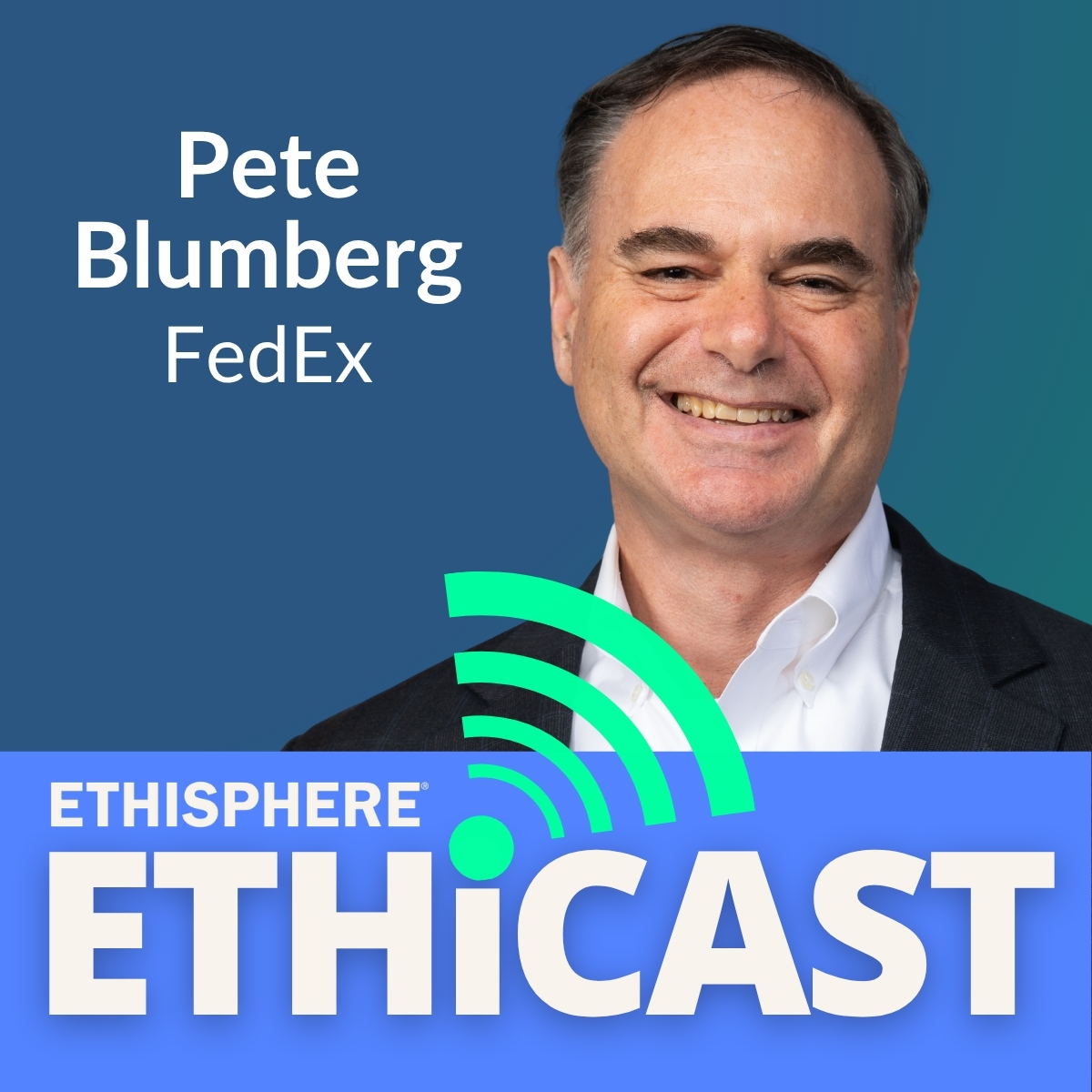
With us today to talk about FedEx's program is Pete Blumberg, Vice President and Chief compliance officer at FedEx. He has global responsibility for compliance programs that guide ethical behavior and support the FedEx reputation as one of the most admired brands in the world. Pete has been with FedEx since 2007 and during his time has handled litigation, internal and external investigations as well as compliance program responsibilities. Pete, welcome to the Ethicast. Thank you so much for joining us. It is a delight to have you here today.
[00:01:54] Speaker B: Bill, thanks for welcoming me and on behalf of our whole team, thanks for this opportunity.
[00:01:59] Speaker A: Now, this is not FedEx's first compliance leader Verification recognition, but as I understand it, both the company and its ethics and compliance program have undergone some pretty significant transformations in that time. So can you talk about that and in particular the challenge of maintaining a high level ENC excellence during a time of transformation.
[00:02:18] Speaker B: There is so much transformation going on at FedEx right now, and the one with the largest impact to our E and C program is what we refer to as one FedEx.
Just for background, really, for the first since we started acquisitions, but for the first 50 years of the company we had a model where each subsidiary of FedEx operated independently. So our FedEx Express subsidiary, our FedEx Ground subsidiary, our FedEx Services subsidiary, they all had their own complete structures, their own finance, their own operations, their own legal, their own hr.
Recently the company has embarked on a process to take the US subsidiaries in particular and consolidate them into one unit. And on top of that, we are in the process of spinning off our FedEx Freight subsidiary into its own publicly traded company.
So what does this meant for compliance at FedEx? So under the old structure, like each operating company and each international region had its own compliance team with the compliance functions reporting up to their own company gcs. And there were some strong legal and regulatory reasons for that kind of structure.
Now with the one FedEx, what we've done is taken all of the compliance and put all under our corporate, corporate integrity and compliance group. And you know, that has allowed for, you know, reimagining of the program, consistency, you know, and for an overall voice and vision for the program.
But probably more critically, even though we've had this centralization and consolidation, we have maintained teams aligned to our global structure. So we have resources dedicated in the US to lac, into Canada, to Europe and to our Asia Pacific, Middle east and Africa areas.
What that does is our compliance can meet the business where they are, have that connectivity to business, to their needs, to their compliance concerns.
But then at the same time, each region, each group has the ability to innovate independently and then we can take the best practices back and then push them out, you know, to the other regions. So it really has in many ways, even though it's a, a challenge to bring different groups together and different practices and different systems, different functions, the benefit has been tremendous.
[00:04:38] Speaker A: What is an aspect of your ENC program that you feel makes an especially important impact on FedEx as a whole?
[00:04:44] Speaker B: So I'm gonna, I'm pick up something a little different that maybe is not often part of these kind of discussions. I'm going to talk a little about cybersecurity and privacy. And even though it's not the ENC program that runs it, it's our annual cyber ransom exercise. And I assume that for a lot of companies, a lot of people listening to the cast today, the corporate compliance program has a large role in data privacy, including addressing potential data breaches and reporting obligations.
So we at FedEx, we conduct an annual exercise that is a massive undertaking. We spend, you know, months putting together a scenario of a cyber incident that, you know, impacts some part of our systems. And every key stakeholder is involved in this exercise. And it used to be a tabletop and now it's, you know, a multi day event includes IT InfoSec Communications operations and the customer facing teams. We also have involvement from our executive leadership team and committee of our board.
And the reason I point this one out is for those who are very heavily steeped in the data privacy area, these kind of simulations really do test your processes. They test your playbooks and your on the fly decision making done right, it does not at all feel like a simulation.
And nothing ever feels like a simulation when you're getting questions from your top executives, your board leadership, who want direct answers to questions. You know, a lot of times in compliance we have the benefit of time, the benefit of a long Runway for certain things that we want to do. And even though this is one area, cybersecurity, there are those occasions in this field where you've got to make fast decisions, fast decisions about maybe disclosure type decisions, fast decisions about what you're going to do in the business. And testing that muscle memory of how you're going to operate on the fly is just hugely important for programs.
[00:06:49] Speaker A: So I know you've been awfully, awfully busy. But I have to ask, what are you working on next and where do you envision taking your E and C program over the next 18 to 24 months?
[00:06:58] Speaker B: One great opportunity area for us is focusing on expanding our engagement with our operations.
And we want to do that through an expansion of our Integrity Ambassador program.
So you know, you hinted at at the opening, the numbers for FedEx are staggering.
We have over 500,000 worldwide team members. We operate in 5,000 operating facilities that are located in 220 countries and territories around the globe.
So really there is no realistic way to get the appropriate compliance messaging out just through site visits.
There are site visits and reasons and opportunities why you're going to do that at certain locations.
But we can't site visit our way to sort of what we're trying to do.
So we are really going to strengthen our Compliance Ambassador program to really have a compliance presence in the end of the day, hopefully in every facility where we operate.
So initially, and this is, you know, not everything works perfectly the first time and a lesson's learned. So initially we're looking to stand up our sort of our own compliance ambassadors network sort of run out of our compliance technology Integrity Organization. But to grow it organically just was not going to happen at the speed or pace that that we wanted. So we're pivoting and now we're looking to do is to change our approach. We have, you know, other functions within our operating facilities, whether it's culture or safety, that sort of already have that, I'll call it compliance mindset. And they're already doing functions, you know, putting safety posters up on the wall, you know, making sure that the annual fire drill is running. So if you take that safety piece and bring into compliance, we already have a lot of the infrastructure in place and we're in the process of expanding our culture ambassadors program.
With ethical conduct being such a foundation of the FedEx culture, it makes far more sense to have our culture ambassadors also be our integrity champions in our facilities rather than stand up a separate function.
The other big focus area for us and probably for every compliance organization around the globe is leaning into AI and leaning into automation.
And as we're looking at it, our top priorities are areas where we can use AI to bring efficiencies to how the business engages with us. I mean, look, we all want AI to make our lives easier, but at the end of the day, where it really shows value of AI is making the lives easier of the people who need our support, our services, our advice and guidance. So for example, expanding the use of chatbots that can respond to routine policy questions.
Automation for intake for conflicts, gifts, travel, entertainment, and look, anyone who's looking at me can see there's a little bit of gray hair. And I think maybe my original reaction was people like the personal service, they like the personal touch.
You know, I'm not entirely sure that's the case. I do think that more and more, you know, our, you know, business customers like the automated approach. They're used to it, they're used to it in their personal lives. They're getting more and more used to it in their business lives. And more and more it's the solution they're looking for. So, you know, I've done a bit of a turn on this and we're going to be employing more AI in our processes. And one other area that I know speaks to everyone is more AI in the investigative process. You know, everything from intake to triage, to engaging with reporters, to report writing, it is a process that the more that AI and the more that automation does that, the more that your investigative teams and your professionals can do the higher level work and the, and the deeper thinking that should be involved with investigations, you know, rather than summarizing investigative notes, for example, with all these benefits and with everything we're doing in AI, you know, it brings with it some amount of risk.
And that's where, you know, we have kind of two hats on AI. There's the AI that we want to use as a compliance team. And then at FedEx, there's the role that, you know, we have in our AI governance strategy. FedEx has, you know, created a global AI policy. We have a generative AI use guidelines, we have an AI center of excellence.
We are continuing to refine and expand our governance structure. As AI changes, our governance structure needs to change.
And so we're aligning with our security, privacy and ethical standards and protecting our customers and brand.
[00:11:33] Speaker A: Pete, why was obtaining compliance leader verification recognition an important objective for FedEx? And I guess more broadly, why do you think it's important for E and C teams to undergo some kind of third party measurement and evaluation?
[00:11:45] Speaker B: Well, I'll take the second part of your question first. The recognition really singles to our team members, our customers and all of other stakeholders that ethics and integrity aren't just statements.
They're truly priorities for this company.
It matters tremendously to the business.
There's more and more focus every day on integrity and compliance in the supply chain.
Look, we're all seeing more questionnaires, more certification requests, more contract clauses that speak to ethics, integrity and core elements of a compliance program.
And while these recognitions don't obviate having to address those requirements and deal with our counterparties, it is just a tremendous starting point where your front line is, you know, know we are recognized as a compliance leader, you know, so there's a huge value there to. The second part of your question is, you know, the value of the external evaluation process. I think I'll sort of explain it this way. I mean, you said at the outset that I started with litigation.
And anyone who's done any litigation sort of knows where I'm going to go with this. You can think or believe, you know, anything you want about the strength of your case or let's transition to your program. You can think you're great, you can think you have a strong program, but it's a whole other thing. When someone comes to you and says, send us your policy, send us your guidelines, send us your alert line stats. We want the compliance committee charter, we want the minutes, we want the redacted deck on this. Like when you have to actually document what you are claiming in a very thorough way, that's when the rubber meets the road. And that is truly like the value in this process is that, okay, prove it to me. And getting the recognition is obviously wonderful. But that proof process is really what is fundamental to our program to say, yep, we have all these things and if we don't, we know we can't answer this question. We're going to go and resolve that.
[00:13:56] Speaker A: I am sure that there's an ENC team out there that is looking at where your program is now and wanting very much to get there themselves. So what words of advice do you have for them? Especially a program that has already achieved a certain level of maturity but is really struggling to break through to that next level of effectiveness and impact.
[00:14:13] Speaker B: The watchwords are to aim for progress instead of perfection. Just try to mature and grow every year, you know, pivoting to the world's most ethical recognition, which we've received in prior years, you know, we did not achieve that honor the first time we applied for it. We applied, we didn't get it.
But what we did get was valuable feedback on, you know, where we fell short.
And over time, you know, we said, well, you know, where did we not measure up? Well, let's build out this area. Let's, let's do that area. And then over time we developed the kind of program to achieve the award.
And that's the challenging yourself, challenging your team and going through that maturity journey and then of course, never settling. I mean, we have achieved world's most ethical. It doesn't matter. We look at our scores and like, where can we do better? Where can we do better? Where can we do better?
And we're never going to sort of stop through that process. The other I would say, you know, for, for everyone who's part of this program is just the importance of benchmarking and meeting and talking to other people in the compliance area and attending conferences. And I'll tell you, in prior legal roles, I was not what you would call a conference guy. To me, conferences were kind of close to like paid time off. You got a trip, you got a hotel room, a few good meals, you got to get away from your day to day work. Now that I'm in a compliance role, totally different view. It is an absolute priority.
Everyone in this field benefits from everyone else's innovation.
And I'll use a little bit analogy, you know, FedEx is at heart, we're an airline and airlines compete vigorously. But all airlines benefit from improvements in safety. Safety is everyone's goal.
And I view ethics and compliance the same way. Wherever people in this industry are, customers, counterparties, vendors, competitors, whatever it is, ethics and compliance, we all have a shared interest in improving, just across all industries, across all people. And so that's why I have changed my tune on conferences and gatherings. And I think it is one of the most important things that either compliance leaders do or people who aspire to be compliance leaders is Learning all the
[00:16:41] Speaker A: Time Pete, it's been great to speak with you about how FedEx approaches ethics and compliance. Congratulations once again to you and to your whole team for your much deserved Compliance leader Verification recognition.
[00:16:51] Speaker B: Bill, thank you so much for the opportunity. I'm hoping this interview was sort of practicing what I said just a few minutes ago about benchmarking and learning from other leaders. I attend these ethicast regularly and I'm really excited to have been a participant.
[00:17:08] Speaker A: To learn more about the great work that Pete and his colleagues are accomplishing at FedEx, please visit their Corporate Integrity and Compliance page at fedex.com we'll include a direct link for that in this episode. Show Notes to learn more about the Compliance Leader Verification program and to see how well your ethics and compliance program compares to that of your peers, visit ethisphere.com solutions thanks for joining us. We hope you've enjoyed the show. For new episodes each week, be sure to subscribe to us on YouTube, Apple Podcasts, and Spotify.
Also, if you haven't already, please follow Ethisphere on LinkedIn to learn more about how we help organizations strengthen and improve their ethics and compliance programs. Together, we can make the world a better place by advancing business integrity.
That's all for now, but until next time, remember, strong ethics is good business.