[00:00:00] Speaker A: Hi everyone. Today we'll look at how Bella Community Champion Award winner Leidos lives up to the notion that there is no competition in compliance. I'm your host, Bill Coffin and this is the Ethiccast.
The Business Ethics Leadership alliance, or bella, is a global ethics and compliance community that provides exclusive access to helpful data, better benchmarking events and other resources to advance your ENC program.
Each year, Bella honors select member companies and individual ethics and compliance leaders for their extraordinary commitment to advancing community engagement, growth and transformation. These are the Bella Impact Awards and they reflect Bella's own dedication to moving the integrity agenda forward for all companies.
In particular, the Bella Community Champion Award recognizes outstanding contributions to the member community by way of content, resources, event participation, publications, mentorship or peer to peer support.
This year, Bella recognizes American defense aviation, information technology, health services and medical research company Leidos, which has also been a world's most ethical company's honoree since 2018 as one of its Bella Community Champions.
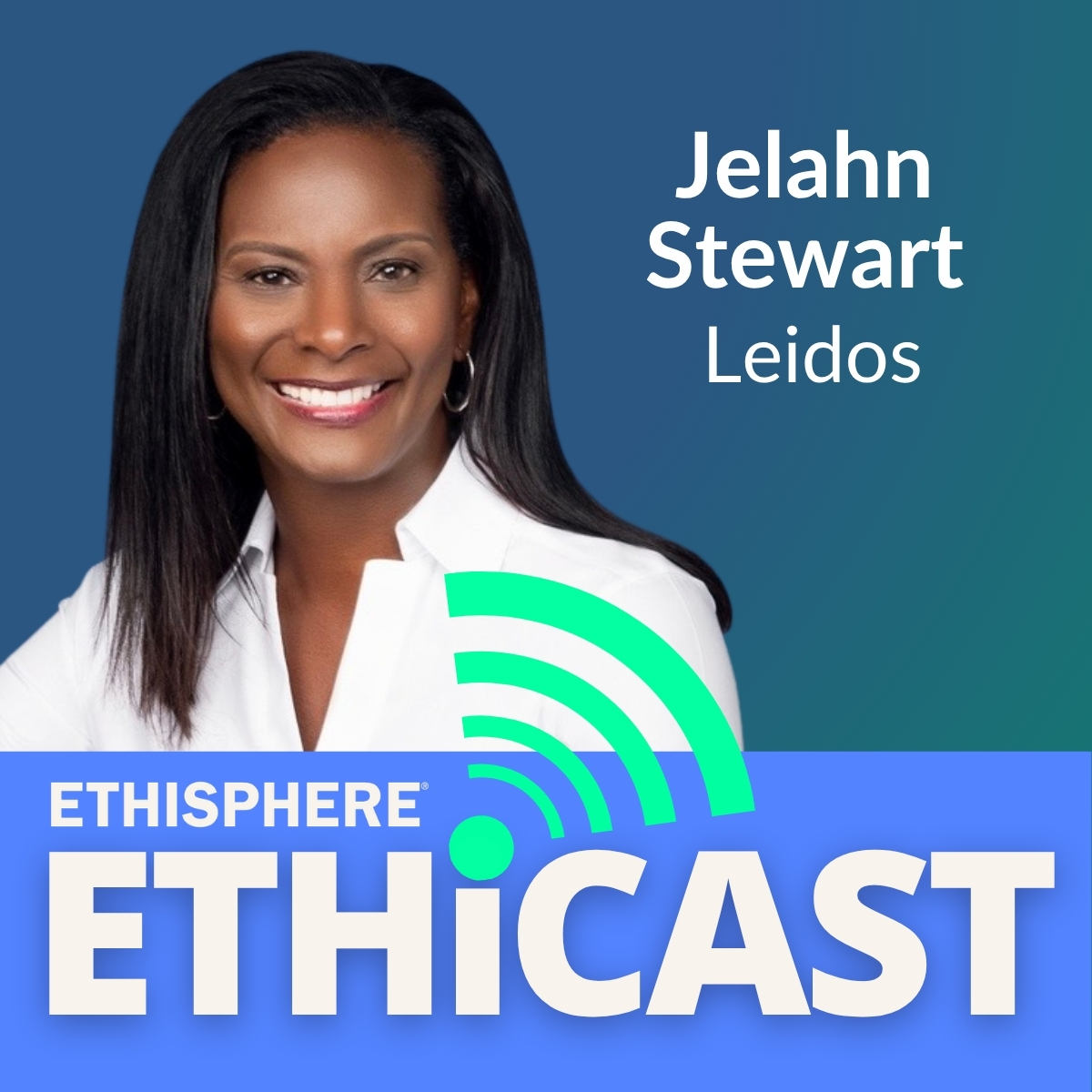
With us today to discuss how Leidos earned this award and how the organization exemplifies the credo that there is no competition in compliance. And is Jalon Stewart Chief Compliance Officer, Senior Vice President and Deputy General Counsel at Leidos, where she oversees the organization's global ethics, compliance and business integrity functions. Jelan provides critical advisory on legal strategy, regulatory risk, enterprise wide controls and corporate governance, ensuring that processes and controls meet both legal and ethical obligations worldwide.
Prior to joining Leidos, Jalon served as Vice President and Special Counsel, Global Ethics Officer at Walmart. She has served extensively with the US Department of Justice, prosecuting high profile cases and training criminal justice stakeholders worldwide. And she is a prolific presenter on legal and ethical issues. Jalon, welcome to the Ethicast. I'm delighted to speak with you today.
[00:02:11] Speaker B: Oh, thank you so much, Bill. I'm very grateful to be here today. Thank you for having me.
[00:02:16] Speaker A: When you and I first spoke about Leidos earning the Bella Community Champion Award, I asked what one of your favorite things about Bella was and without hesitation you talked about how helpful Bello resources were to you. So can you talk a bit more about that, especially how they have helped you achieve your E and C goals at Leidos?
[00:02:33] Speaker B: Absolutely. So the Bella resources are phenomenal, particularly the member hub. Our ethics directors at Leidos use it regularly. It is not a resource that sits unused for us and we really like it because it really offers practical tools, not just theoretical concepts on how to enhance your program.
And I can give you a recent example. We were looking to enhance our conflict of interest program and so we turned directly to the member hub and found tremendous resources.
Our ethics directors found sample policies from member organizations, ethics fair quick help guides on how to draft the coi a conflict of interest policy, Roundtable recaps and I love round tables, but obviously I cannot get to all of the roundtables. And there are roundtables on particular issues that I can't get to. But there are roundtable recaps on conflict of interest that were available in the member hub.
Also ethicast episodes, which are deep dive interviews into particular subjects like conflicts of interest.
And one thing I really love is the benchmarking that you can get. So for example, we can go on and look at how other programs have developed their conflict of interest policies and how they use it, what kind of training do they offer, who they offer the training to, how often do they offer that training. And so that benchmarking can be really helpful. And another thing that I absolutely love are the toolkits and conversation starters. And in fact we offered a conversation starter on conflict of interest, but we were able to see what else was out there, what other companies were doing. And these resources are so helpful because when you develop your framework for your program, you can actually pressure test it against what other companies are doing so that you can know that you're not on an island by yourself. But also you can have confidence in the tools that are out there because these are products or items that other companies have actually used in practice so we know that they work. And so for us, being able to dive directly into that member hub and use those resources was particularly helpful. And it helped us in particular go from just sort of the concept of enhancing our program to move directly into execution a lot faster. And when you're able to move faster, you're able to be more agile.
[00:05:16] Speaker A: Now you mentioned Bella Roundtable, so I'd love to dig a little deeper on that. What has your experience been with Bella Roundtables as a way to share information, but also to get a sense of how other leaders in the ENC space are meeting the various challenges and opportunities of today's business integrity environment.
[00:05:31] Speaker B: Yeah, I absolutely love the Bella Roundtables. I've been fortunate enough to be a presenter at the roundtables and also an attendee. And I think it is absolutely fantastic. It's really an authentic is really a way to engage in authentic, candid discussions with our peers about real pressures that we're all experiencing.
We can exchange insights on regulatory requirements if a new rule or law has rolled out. We can talk together about how it's impacting our companies.
We can talk about enforcement trends. If there's a big enforcement action that has been, that has been taken against one of our peers, we can talk about the things we're doing to prepare our companies to prevent those types of things.
And then it's also a good way to measure the pulse on our culture and compare it to other companies.
For example, when executive orders rolled out, how did those impact the culture in their companies?
And it's really kind of comforting to understand, well, the peer organizations are experiencing the same thing.
We're not out of the ordinary here. The thing that's so wonderful about that is it allows our program to evolve in alignment with the broader profession. And this is insight you can't get from any written guidance.
Being able to engage is just invaluable. And personally, I love it because it just reassures me when I'm able to talk to my peers when they're experiencing the same thing, that, like I said, we're not alone.
[00:07:17] Speaker A: Now, you've spoken about how you've both taken from and given to the BELLA member hub. Can you talk about a resource in particular that you shared with your fellow community members and more like, what was that process like? And, you know, what drove you to share the resource that you shared?
[00:07:31] Speaker B: Bella works because it's not just about taking, it's about contributing as well.
And we all, all of us have this shared commitment to strengthening our profession.
And so, you know, with that as the background, we thought about what could we share that would be practical and helpful to any of our peers?
So we took a look. The process, you know, involved us doing some reflection on what we had to think about, you know, what have we. What have we done? Didn't have to be anything big, but what have we done that we can share that would be helpful to our peer companies? And so we looked at our conversation starters and also some of our templates that we have with regard to the conversation starters. We provided it in a manager's toolkit, and we wanted to provide help to leaders to facilitate discussions with their teams for their use at staff meetings or even informal gatherings of employees.
And the reason we picked that was because the research shows that the more managers talk about ethics, the more likely employees are to feel comfortable about ethics and raising concerns.
So these tools were really designed to facilitate those types of discussions.
So in the toolkit, the manager's toolkit, we provided a short slide deck with scenarios, common scenarios, and we actually included one on conflict of interest.
It also includes discussion questions Key takeaways and talking points to help the managers through the conversation, and also tips on how to close out the conversation when they're feeling.
So in addition to those conversation starters, we also provided onboarding communications. This was a simple email. It's a template of an email that we send to new leaders who join the company, and it establishes our expectations around Speak up culture. And we also provide points of contact for our ethics directors. And this really sets the tone. So when an employee joins our company, they know that we prioritize ethics. We let them know what our expectations are and we give them a way to connect with us. And it might not seem like a big deal. It's a simple email template, but we thought we got tremendous response for it, positive response from it, and so we wanted to just share that along with our peers.
[00:10:06] Speaker A: Well, I hope you don't mind if I pay you a compliment, but I've taken a look at these resources myself and Leidos produces some very, very sharp resources. So you guys have definitely enriched the member hub by submitting those to the community. So I want to thank you for.
[00:10:19] Speaker B: Oh, well, thank you. We're happy to do it. And like I said, we're happy to take and receive and give as well.
[00:10:26] Speaker A: For folks that might be new to the Bella community or that may be with organizations that are perhaps a little earlier in their ethics compliance maturity journey, and they may not feel like they've got permission to submit to the Bella member hub. What recommendations do you have or advice you can give to organizations that maybe want to contribute a policy or, or an asset to the Hub, and they haven't done it yet. And they're kind of trying to figure out their way of doing this in terms of their own confidence.
[00:10:52] Speaker B: Right. So let me just address one part that you said. If they don't have permission, they don't feel like they have permission to contribute to the Hub. The first thing you need to do is absolutely get permission from all the higher ups before you share and make sure you do the necessary redactions because we want to be sure that we are not disclosing confidential information or disclosing confidential corporate information. So that's the first thing I would say.
But once you do have that permission, there is nothing too small or too great that you can contribute. I think that you should just do this simple analysis and ask yourself, if you built something that solved a real problem in your program, then it's likely to have value for someone else.
And don't underestimate the value of a template. Or a process flow or a conversation starter, just because it's routine. To us, Bellum members are at all levels. Like you said, they might just be starting out. And you know, this simple email template that we've provided could be an enormous help to even the more mature programs. So for them, I actually have four recommendations for people who are thinking about sharing a resource and may just be a little bit hesitant. I would say first of all, share resources that have actually been implemented, not just drafted.
Because one of the benefits of taking from Bella is we know that these are our tools that have actually worked in practice. And so if you provide something that has already been implemented, we know that it's been tested and it's not. And it will also reflect lessons learned, not just sort of the design intent.
Also, I would say provide context, explain what issue the resource is intended to address, what risk does it mitigate, and what adjustments you made along the way.
That's often as helpful as the document itself because it guides others onto how it might translate in their environment. So, for example, if we sent out that email template and we got a bunch of responses that we didn't intend and so we tweaked it a bit and then, you know, once we sent it back out and didn't get those the same responses, we are going to share that so that when a BELLA member uses that resource, they'll not make the same mistakes that we made.
They'll be able to benefit from the lessons learned that we had.
The third thing I would say is don't wait for perfection. We want to make sure that it's something that's been implemented. It doesn't have to have been implemented for five years, you know, before can share it. Compliance is iterative by nature and you know, our enforcement priorities change laws, change climate change, and our programs have to change with it. So if you have something that has worked in practice and advanced your objective, I encourage you to share it. It will be useful to someone.
And then finally, think in terms of friction reduction. If your resource can help another leader move from concept to execution faster or or avoid a common implementation misstep or strengthen board confidence in your program, then it's worth sharing.
[00:14:13] Speaker A: Well, Jelant, thank you so much for joining us today and once again, congratulations to you and to all of your colleagues at Leidos for this much deserved Bella Community Champion Award.
[00:14:22] Speaker B: Thank you so much. We are so grateful to receive it. And it's a reflection of not only my hard work, but the hard work of my entire team here at Leidos thank you so much, Bill.
[00:14:33] Speaker A: To learn more about the great work that Jelan and her colleagues are accomplishing at Leidos, please visit their Ethics and Business integrity
[email protected] we'll include a direct link for that in this episode's show Notes. To learn more about Bella, visit ethesphere.com Bella to request guest access to the Member Resource Hub and to speak with the Bella Engagement Director.
Thanks for joining us. We hope you've enjoyed the show.
For new episodes each week, be sure to subscribe to us on YouTube, Apple Podcasts, and Spotify. Also, if you have not already, please follow Ethisphere on LinkedIn to learn more about how we help organizations strengthen and improve their ethics and compliance programs. Together, we can make the world a better place by advancing business integrity. That's all for now, but until next time, remember, strong ethics is good business.
[00:15:26] Speaker B: It.