Episode Transcript
[00:00:00] Speaker A: Hi, everyone. In this episode, we'll look at how AI is transforming misconduct investigations, both in how they're being carried out and how misconduct itself is being reported.
I'm your host, Bill Coffin. Welcome to the Ethicast.
Internal investigations is an aspect of the ethics and compliance function that faces considerable pressure thanks to an increasing volume of misconduct reports worldwide.
This only adds to the ongoing tension ENC teams face with ever expanding remits and responsibilities without necessarily receiving additional resources with which to address them.
Into that mix is artificial intelligence, a transformative technology that has given so many ethics and compliance teams an asymmetrical ability to cover a lot more ground than ever before.
In few areas is this more visible than in misconduct investigations, where AI enables teams to process vast amounts of data with unprecedented speed, discover fact patterns that human operators might miss, and reduce the overall amount of time an investigation takes from weeks to perhaps only days.
These changes are not universal across all ethics and compliance programs, of course, but the degree to which AI is transforming investigations is something ENC teams cannot afford to ignore.
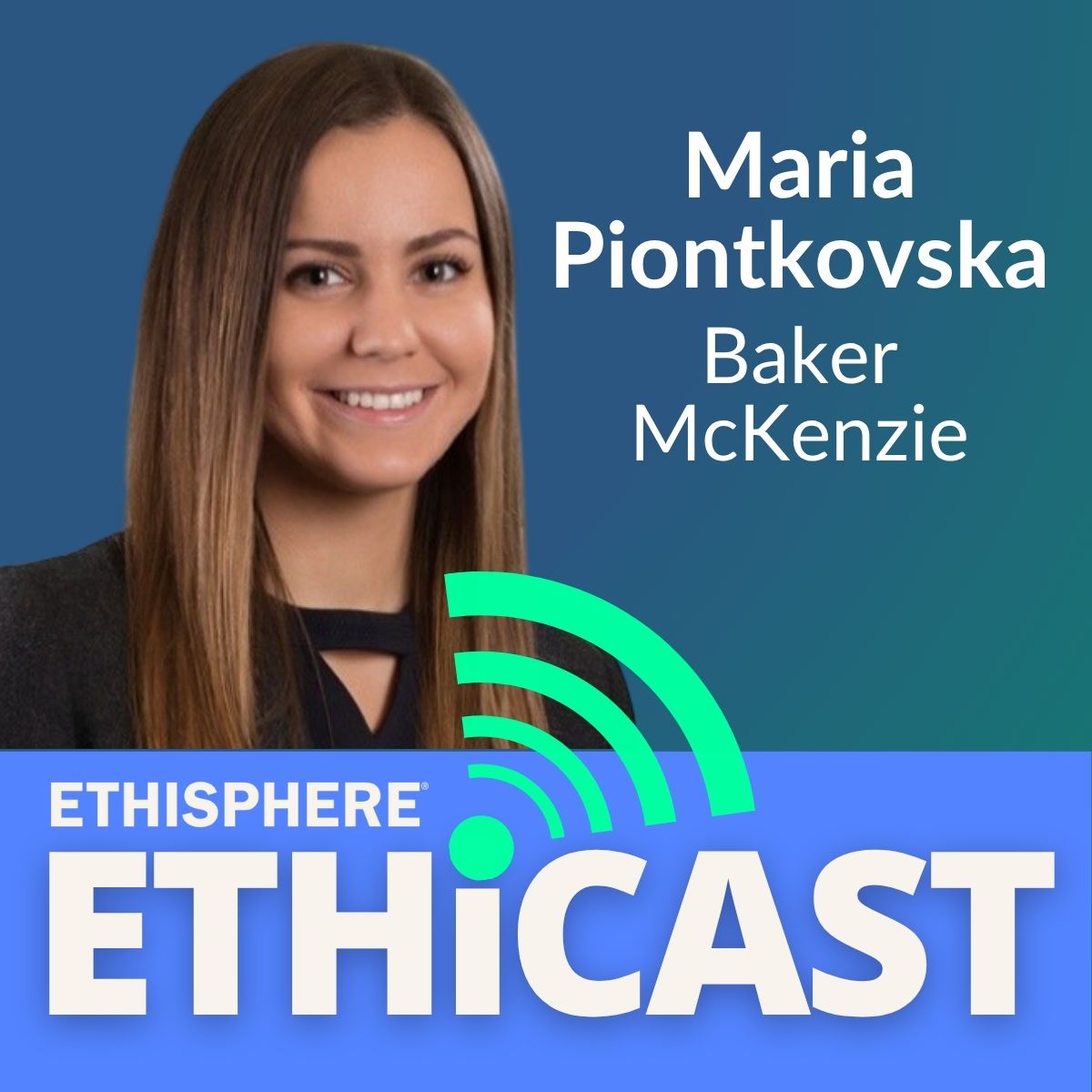
With us today to talk about this is Maria Piankowska, a partner with Baker McKenzie's litigation and government Enforcement Group, co editor of the firm's Global Supply Chain Compliance blog, and a member of the firm's technology, Media and Telecoms Global industry Group. Maria's principal areas of practice are corporate internal investigations, corporate compliance, and broader regulatory risk management. Maria, welcome to the Ethicast. It's wonderful to have you on today's show.
[00:01:52] Speaker B: Hi, Bill. Thanks so much for having me.
[00:01:55] Speaker A: What are some of the more novel uses of AI that you're seeing right now as a tool to advance investigations? I'd be especially interested in hearing about how AI is speeding up documentation review and early case assessment.
[00:02:08] Speaker B: Yeah, so I think there is a lot of really exciting tools on the market and really cool use cases.
With the way how compliance departments are using AI tools to not only expedite their investigations, but also to just materially improve the quality and the sort of involvement of the business and feedback to the business that they could give to the business in real time as they're working through the investigations. From the Gores tabular review, that can be very helpful in summarizing categorizing documents of a similar format, such as invoices, for example, to other tools that are focused on building out chronologies or. Or integrating chatbots into your ediscovery system.
There's just lots going on in this space that has us all very excited.
And I truly believe that once the dust Settles and, you know, we're all more comfortable using AI tools and kind of have a better understanding of what they're good for in the compliance and investigation context. The way we do investigations is going to be completely reimagined and a lot less. A lot more seamless than it is right now. But one area I'm most excited is early case assessments. This is something that sort of we as a firm have been working on lately. And I think the idea behind that concept is that investigations often take a long time, and not just the document review phase, but also just trying to figure out who they write custodians are.
What are the correct questions to ask? What are the search terms that you should be running? Like, what are the key terms that the interviewees were using to refer to the facts that are of interest to you? And all of that just used to take weeks.
I think with AI and with its ability to parse through large amounts of data quickly, there is an opportunity there where we could take the data that may not be like a perfect data set. You know, it may not include all the custodians because you don't know what you don't know. And in early stages of an investigation, investigation, that information is just not available to you yet. But you can still take sort of what you think is most likely to be relevant to the allegations you received and sort of use that with the help of AI to really scope and focus your investigation in a way that you weren't able to do before. And I think that sort of serves multiple purposes, not just in terms of expediting the investigation itself, but also, frankly, to help companies allocate resources appropriately. Like, you don't want to spend weeks and, you know, hundreds of thousands of dollars looking into something that you could have discovered within a few days is just completely not true or sort of not justified. At the same time, there are cases where you do want to make sure you, you know, you look into those allegations thoroughly, and that's where sort of AI can help you identify which ones those are.
[00:05:04] Speaker A: How much are you seeing people using AI to report misconduct?
And are you seeing the use of AI changing how people frame their misconduct reporting?
[00:05:13] Speaker B: Yeah, there have definitely been some noticeable changes on that front.
I think they're best described sort of. There's a twofold impact, I would say, of AI on reporting. One is just purely on the volume of reports received.
I think a lot of our clients are seeing an uptick in complaints that they've been receiving through compliance reporting channels. And there's A few reasons for that. Some of them are AI related.
First, I think people are a lot more comfortable using, especially the publicly available AI models to just run their concerns by them and see if this is something that AI thinks is actually worth escalating.
And, you know, obviously AI, as we know, can be pretty sycophantic. And I think it almost never tells you that this is not something, you know, you should report. It's not a big deal and nobody else is going to be interested in this. So I think a lot of people are getting reassurance from AI that their concerns are indeed legitimate and should be raised. And further, AI is helping them frame these concerns in a way that are more likely, that is more likely to attract attention of the compliance department and to sort of get to the right people, more senior people to be looked into.
And that's another challenge, right, because as compliance professionals, sort of build that muscle to be able to look at the complaint and be able to say right away that, like, hey, this was AI generated.
And then you're kind of tempted to just dismiss it based on that because you're like, oh, this is probably, you know, not worth my time. I would caution against that because obviously, just because something has been written with the assistance of AI doesn't mean it's automatically, you know, not legitimate. There still can be some valid concerns there, but there are some pitfalls. And, you know, you do have to sort of really focus on the facts that have been alleged as opposed to, you know, various citations to cases that may not exist or citation to, like, alleged policy violations. All of that is kind of fluffed, meant to get your attention. But when you focus on the factual side, which is less likely to be hallucinated or overstated by AI, that's where you know, compliance professionals should really focus when they're triaging and scoping their investigations.
Another way I think that AI encouraged reporting is by making it a lot easier for employees that are based in countries where English is not the main language of communication to kind of be more comfortable raising those complaints before, you know, maybe they would think that.
I'm not sure I can phrase it the right way. I'm not sure I can accurately describe what happened to me. So I'm just going to let it go and I'm not going to bring this to anyone's attention. Whereas now it's like, well, I can use AI to help me draft this, translate it into perfect English and send it out and be kind of more confident that I'm not misunderstood as offices
[00:08:11] Speaker A: conduct meetings remotely through platforms like Zoom and Teams. They often make use of AI driven meeting summary and transcription tools. And these tools can be turned on by default when the meeting is scheduled. So I'm wondering how often are you seeing such transcriptions and summaries appearing as investigations evidence and are there any admissibility concerns around that?
[00:08:32] Speaker B: Yeah, so I think that's very new. So I would be lying to you if I told you that, you know, I see it all the time, but it does come up. I think it is going to prove to be a new sort of source of evidence moving forward. And as with everything AI, I mean, what we're seeing is in real time is how the legal system is kind of trying to apply the old rules to these, you know, now new facts and trying to make it work.
So so far it looks like the courts will continue to apply existing rules of evidence. And that raises two issues, which is consent and authentication. Right. So under federal law, any recording, for it to be legal, one party of the conversation at least has to consent to the recording. But many states have rules where all parties to the conversation need to consent, otherwise you can't use that recording. I'm not even going to talk about EU and some of the other countries where rules are even stricter. So on the consent side, there's a lot of issues precisely because of the, you know, often default setting where the meeting is recorded and transcribed or summarized after.
And I think it's really difficult to argue that there was affirmative consent in those cases because at most there will be like a note in the meeting invite saying, you know, this meeting is going to be recorded and transcribed whether you saw or not that note. You know, that doesn't mean you affirmatively consented to being recorded. I think there is a better chance to sort of make that argument if there is a pop up notification before the meeting where you have to kind of like check a box and say that you're okay with the meeting being recorded and transcribed. But again, you know, depends on the jurisdiction. So I think that's sort of a risk that everyone needs to be mindful of. And there is ongoing litigation regarding these issues right now. I also wanted to mention an anecdote that I have kind of related, but not really about meetings being recorded. And you know, by virtue of these default functions is where we had a client where they recorded the meeting and there was a default setting that was applicable to sort of a cadence of this meeting. So nobody really sort of remembered or paid attention to it, but the setting basically sent out the recording and transcript of the meeting, after the meeting to everyone, like to a set sort of circle of recipients. And it just so happened that this meeting was actually about one of the participants. And it was like a sensitive investigation HR issue. So it was just a very awkward position to be in. Obviously raises all kinds of concerns.
And yeah, they were not happy about the development. But at the same time, I think once you get used to having the transcript available or having a summary available afterwards, it's kind of hard to give up because it does make your life easier in many cases. Right. For meetings that are not particularly sensitive or involve lawyers, authentication is another issue that's going to arise in the evidence context. And I think there, I mean, there's an important distinction between transcripts that are AI generated and evidence that is enhanced by AI. And there was a case where sort of a very blurry video that one of the parties to the case wanted to use as evidence was enhanced by AI because they, you know, otherwise it was basically not very usable. And the courts basically decided that you, you can't do that because there is no way to ensure that the way AI enhances this video recording is not, you know, beneficial to one party or another. That in fact kind of accurately depicts what happened on that video. But with AI generated transcripts, I think as long as there is someone who can authenticate who was actually present at the meeting and can authenticate that the transcript, you know, corresponds to what actually has been said, there's still things that you have to pay attention to because there can be hallucinated statements or misappropriated statements in the transcript. Sometimes, you know, the recording didn't adequately hear what's been said, so it's going to make something up or just omit the statement entirely. And then you have to kind of grapple with, well, was that important enough for us to argue that, you know, that invalidates the whole thing?
So, yeah, definitely some issues around that and everyone is kind of just trying to figure it out as they go.
[00:12:49] Speaker A: How are you seeing companies use AI to help with investigative interviews? I mean, AI has become such a widely used content creation tool that we can imagine people using it to help, you know, craft interview questions. But are you seeing AI play a role other than that in investigations themselves, like comparing interview answers between parties to look for inconsistencies or to detect evidentiary gaps?
[00:13:11] Speaker B: Yeah, so I think most companies are taking a pretty cautious approach to this and are using AI in a way you've described where, you know, they help it with prep for investigative interviews, to help draft interview outlines. We have seen some clients, and I mean, we have done it for some of our clients as well, where before an interview takes place, we kind of run all of the transcripts or interview notes that we have through a tool that we have that basically points out inconsistencies or contradictory statements. And it just kind of highlights issues for you to run down during the interview, which is tremendously helpful, especially in investigations where there have been a lot of interviews and a lot of witnesses involved. So you get a chance to kind of just speed up your own preparation process in a very meaningful way. But I think what many practitioners are talking about is the future of using AI in interviews is particularly pointing out witness statements and inconsistencies in real time while you're talking to the person. Obviously it ties into the transcription issue we just discussed.
You have to be comfortable with recording and transcribing the interview in real time to begin with to be able to get to this point where you're comparing different witness statements and kind of reacting to them in real time. But because of how convenient it is, it's hard to imagine how this is not going to exist in the near future in some shape or form. And then, I mean, there are some completely sort of utopian, seemingly utopian, although, you know, crazier things have happened, if you ask me, ideas out there where, you know, you will have, like, video recordings of witness interviews that with cameras that are going to like, measure body temperature and body language and point out to you when someone is potentially lying or sort of how their body is reacting to this question or another. I mean, that all seems very invasive, but there are conversations had around that as well.
[00:15:13] Speaker A: Well, Maria, thank you so much for joining us today. It was wonderful to have you on the program and to get your insights on how AI is impacting the world of investigations. Thanks so much.
[00:15:22] Speaker B: Thank you, Bill.
[00:15:24] Speaker A: To learn more about the work that Maria and her colleagues are up to, visit bakermckenzie.com out now is Ethisphere's latest study, the State of AI Adoption in Ethics and Compliance. This groundbreaking piece of research, produced in partnership with Athena, polls 134 senior ENC leaders to explore the gap between how much ENC is handling AI governance versus how much they are implementing AI in their program's daily operations.
To read the report for free and to try our interactive AI benchmarking tool, go to ethisphere.com and visit our resource center.
That's all for now. We hope you've enjoyed the show for new episodes each week. Subscribe to us on YouTube, Spotify and Apple Podcasts. Also follow at the sphere on LinkedIn to learn more about how we help organizations like yours make themselves more successful and more resilient by advancing business integrity.
Thanks for joining us. And until next time, remember, strong ethics is good business.