Episode Transcript
[00:00:00] Speaker A: Hi everyone. Ethisphere has released the State of AI Adoption in Ethics and Compliance Report, a groundbreaking piece of research around how E and C teams are implementing AI in their programs. And in this episode, we'll look at the data that informs that report. I'm your host, Bill Coffin. Welcome to the Ethicast.
The Cobbler's Children is an old story about a shoemaker who outfits the whole town while his own children go barefoot. This summer, Ethisphere and Athena partnered to publish The State of AI Adoption in Ethics and Compliance, a report that surveyed 134 organizations representing senior ENC leaders around how and where they were adopting AI into their programs. What we found was that ENC teams faced their own version of the Cobbler's Children fable. They spent two years writing the AI rules for their enterprises, approving tools, drafting guardrails, building governance. But what we also found was a surprising gap between how much ENC governed AI versus how much ENC actually implements AI. In fact, 67% of organizations have reached broad or advanced AI adoption, yet only 22% of the ENC functions inside of those organizations can stay the same. Their governance mandate arrived before the function's own build out. This report also explores four patterns that explain how the gap formed and where the fastest moving programs are already pulling ahead. A benchmark to see how your program compares by industry, revenue and team size and a sequenced 12 month action plan for closing the gap.
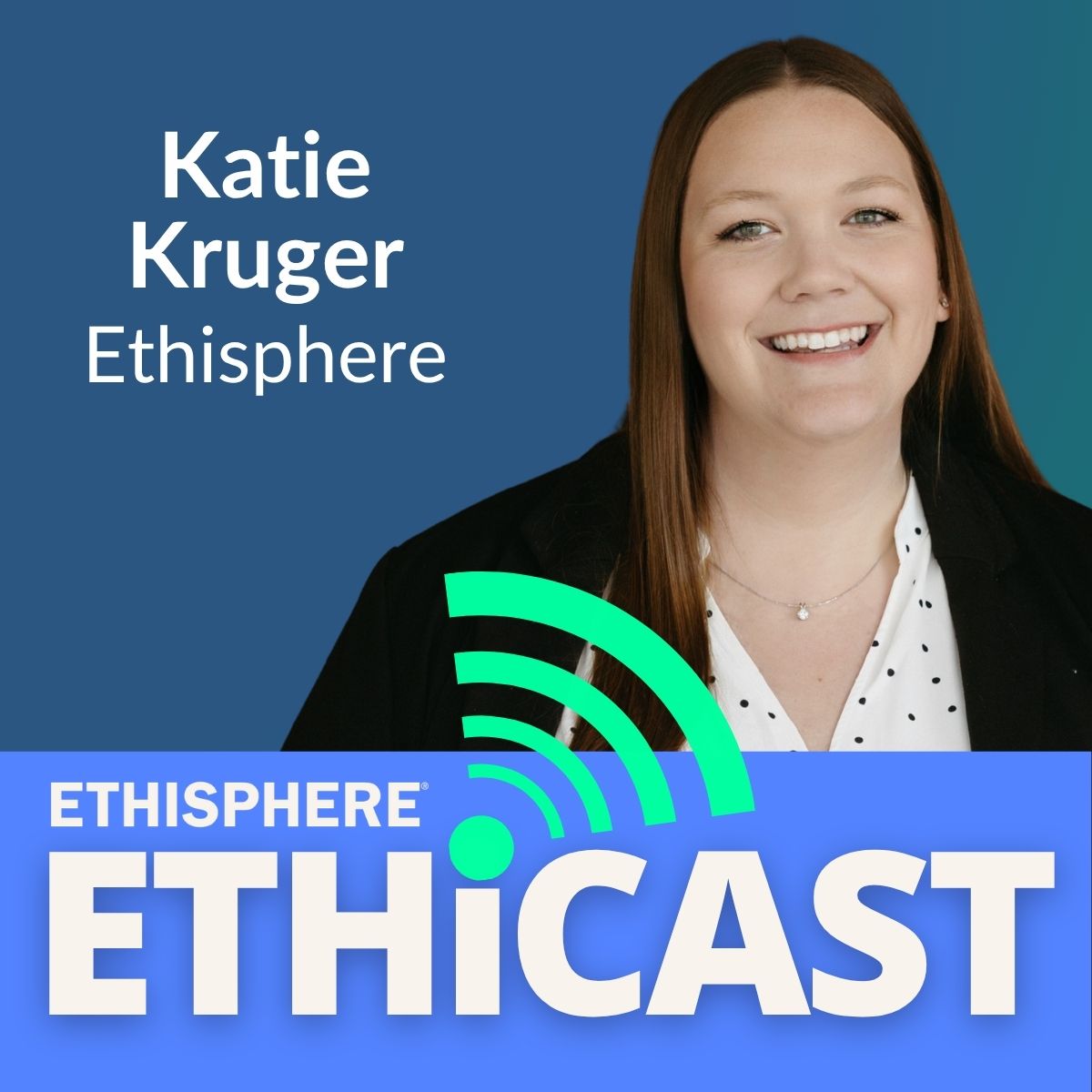
With us today to talk about this is Katie Krueger, Senior Culture Analyst at Ethisphere, where she transforms employee feedback into clear, actionable insights that help organizations strengthen their ethical culture.
Katie works closely with ethics and compliance leaders to understand how employees experience speaking up in the workplace and uses data driven analysis to identify opportunities to create environments where raising concerns is safe, expected and effective. Katie also played an important role interrogating the survey data that informs the state of AI Adoption in Ethics and Compliance Report. Katie, it's so good to see you. Thank you for joining us on this program and especially for this topic. I've really been looking forward to talking to you about this.
[00:02:20] Speaker B: I'm so glad to be here, Bill. It was so fun to work on this project with you and with the broader Ethisphere team and I'm excited to talk about it today.
[00:02:29] Speaker A: Well, let's start off with a pretty simple question, but this is the one that's been kind of burning for me, which is what is the study finding that particularly surprised you in this? Because I know we talked a lot about there was so much data that came out of the effort that generated this report. And everybody, I think, on the team had their own aspect of, you know, huh. I never expected that.
What was, what was that moment for you?
[00:02:50] Speaker B: Maybe it's just my data brain and the way that I think about the world, but I think also a little bit my experience working with ENC teams and working with businesses, you know, I think that KPIs and metrics are so prevalent everywhere. So it was kind of surprising to me the number of teams that aren't really measuring much about AI's impact with defined metrics, namely the large teams, that was super surprising. But really, overall, the results showed that people want to, but the fact that it isn't happening.
We know the cost of AI isn't cheap, whether financially, environmentally. So it was interesting that there was a kind of a lack of clear value tracking.
[00:03:40] Speaker A: One of the things that really surprised me about this when we were putting this together was how, you know, we did this great survey of organizations that really, I think, presented a pretty wide cross section by size, industry geography, so to speak.
And, you know, no matter how AI was, no matter how AI was governed by ENC versus how AI was used by enc, there are lots of different use cases and lots of different differences. But there are these various different ways. No matter how big your organization was or how advanced your ANC program was, or how centralized it was, or how advanced your AI use was, by some way or another, eventually organizations came to back to this gap. Like they all, in some way or another, by different roads, came to the same destination, which was teams are governing this stuff way more than they're actually making use of it. Even though we know, and we see that, you know, AI provides an asymmetric ability for ethics compliance teams to do their job better, right? There's things that they can really, really supercharge their function on if they have the tools in hand. So seeing that gap in so many different ways was really interesting to me. And that's why I really appreciated your data brain on this. Because, look, as I like to say, I'm an English major, right? Like, I've got journalism background.
Torturing data and making narratives out of it is my specialty. But it's not what we wanted to do here, right?
We wanted to have an honest look at what do these numbers say and what do they mean and where do they bring us.
That's why I really appreciated your adherence to, really, you were so scrupulous about how do these numbers line up and what do they actually tell us.
[00:05:14] Speaker B: Numbers are so interesting, but it's the story behind them. So our partnership really made this one of the most fun things I've done all year.
[00:05:23] Speaker A: Well, in this study, we frame ethics and compliance as the cobbler's children when it comes to their imbalance between governing enterprise AI and having AI to use themselves.
How big of a piece of the pie does EC really have and how big do you think it should be?
[00:05:39] Speaker B: AI is just moving so quickly, you know, that if we're spending the time writing the rules, we may not even have time to taste the pie at all. And I think that that's what makes it tricky is that, you know, ENC teams, to continue with this pie thing, are just not really sure how good of a recipe it even is because they've never made anything like this before. And I think it's, it has to be a balance. How big of a piece of the pie should EMC have? Well, you know, eating an entire pie for yourself would make you sick. And nothing really in ethics and compliance should be the sole responsibilities of the E and C team. Right? So yes, ethics and compliance needs a formal piece of the pie, but it's really the responsibility of everyone at the company, not just ethics and compliance, to make sure that their own AI use fits within ethics, fits within the policies.
And this is kind of culture data a little bit, but we really see that the change is affected at the closer levels. So ENC can set these policies certainly, but whether or not it's being followed, whether or not choices are compliant, in a way, when it comes to AI, it really is a trickle down effect at all levels of the organization. Organization, we need people that are making safe choices. And I think that it gets really tricky because so much of ethics and compliance's work is so sensitive and so confidential. And we see that in the survey. Right. So the things that ENC is already doing with AI are kind of the safer bets. So the creation of communications or refining training or, you know, the things that don't involve employee data, and I'm sure employees across the organization are grateful for that. But it does put EMC teams in a position where their adoption is lagging their organizations in some cases.
[00:07:55] Speaker A: So when we put this, this report together, we conducted a wide swath of research and you and I both know that we got a ton of really, really interesting data in this, but we also didn't want to drown people in data as well. When it comes to AI, people are looking for solutions and we want to make sure we kind of presented this in a way that was short, sharp, to the point and gave something actionable to people that they could use to help their programs right away.
So there were a lot of interesting pieces of data that didn't make it into the report that we surfaced in the original survey. I'm curious, what's a data point that we surfaced that didn't make it into the report that you think is worth noting?
[00:08:35] Speaker B: I'm going to go back to this metrics idea.
So the, a couple specific numbers that we didn't put into the report. Only 4% of respondents are formally measuring AI's impact when it comes to defined metrics.
And 42% of the respondents say they don't measure AI impact at all. And it's just so interesting and like I said earlier, surprising to me because especially as ethics and compliance teams look to govern AI, I think if there aren't clear metrics on where it's being used, the value it creates, the time it saves, if there are errors, and if there are non compliant uses, if we don't have these important metrics, then it's going to be more and more difficult to govern.
I think we really will need those to govern responsibly. Is it improving decisions? Is it reducing risk?
Without a target, we're just like shooting into thin air.
[00:09:46] Speaker A: Yeah, yeah. And I think those numbers were especially interesting to note given how data centric, a lot of high performing and mature ANC organizations have really become. Right, like, like you talk to, you know, your average world's most ethical companies honoree and tell them, you know, and show them like the 4% figure that would probably, you know, really, really water their eyes. That's just, that's such an anathema to how they approach things. And I would like to think that in organizations where there's this really big gap, ENC can use their, their familiarity with data to kind of make that case where, you know what, we need to be measuring this in a much more robust fashion because otherwise, like you said, you're just, you're just, you know, swing and not really knowing if this is working or not. And an ENC can never afford to be in that position. They have to be able to measure what it is that they do in order to prove the value of the function.
[00:10:37] Speaker B: I think a lot of it is sharing that pie again though, and something that I think is lacking the measurement or at least my exposure to it is the different, different teams and how they're approaching AI. But I think that I would surmise and this is all my own thoughts, but I would imagine that the lack of metrics isn't.
Well, I know from the data, it's not a lack of desire. It's. I think that a lot of people just don't. Don't know how to do it yet.
AI is so new and like, how do we effectively and efficiently measure these? And it's going to take really cross functional cooperation to gather that data. And that. That's tricky. It's already difficult to work cross functionally on any given day with any given topic. But with something as new as AI, ENC isn't the only team trying to figure it out. And metrics, I think, are difficult to nail down when it comes to how to measure AI, but it's something that teams are going to need to be working on. ENC teams, but broader teams.
[00:11:55] Speaker A: This entire project would not have been possible were it not for the participation of members of the Business Ethics Leadership alliance or bella. Right.
We're all huge fans of BELLA here, but I'd love to get your thoughts on how do you view the Bella community in terms of it being a bellwether for the broader ENC profession?
[00:12:14] Speaker B: One of the absolute best parts of working for Ethisphere is working for and on behalf of the Bella community.
So when this opportunity came up to participate in this report, I was very excited because I value the community's perspective so deeply. You know, anytime I'm in a room with Bella members, whether it's virtual or in person, everyone is so kind and everyone is so warm. But more importantly, I always learn something and I'm always challenged.
And I think that that really is how Bella serves as a bellwether. You know, they, the, the community members aren't just responding to change. They are participating in crafting how this will look in the future.
And for this survey and this report, yes, but even more widespread, the willingness to collaborate and learn together and share knowledge, I think is what makes the community so special.
[00:13:23] Speaker A: Yeah, I couldn't agree with you more. You know, we often say there's no competition in compliance, and I think nowhere do you see that in evidence more than amongst the members of, of the Bella community. I mean, they really, really believe it. And if you, if you're a member of Bella and if you can get it into the Bella member hub and see all the resources that they share there, you see that like a big part of the Bella culture is people sharing the best practices of their own, their own program. Not to flex, but to kind of showcase. Here's what's working for us? Take from this and fold it into your own organization. So when we reached out to the community for this particular survey, I knew we were going to get some great detail because, you know, those who could respond were going to respond and give us really great data with it, and they did. I think this report would not be what it was had it not been for Bella really leading the charge on this and having a real investment, like, they wanted to know this as much as anybody. And they were like, no, this report is a good idea. We want to make sure this happens. And so grateful, as always, to the members of Bella for making this happen.
In the survey results, we had some really great open answers from survey respondents. Among those, did any of those kind of comments stick out to you or provide you with any particular kind of insight?
[00:14:33] Speaker B: I learned a lot from the comments, and there was one that really did stick with me and I think really captures the lesson on how we need to move through this AI boom.
But more broadly, my interpretation and the way I will carry it with within me is thinking about how to move through any significant change. So the contributor wanted to remain anonymous, but I'll still read the quote. So it says, employees learn by doing. There's limited need to provide extensive AI training, rather provide sandbox opportunities and encourage trial and error. No one gets it right the first time or the 20th time. Normalize experimentation and learning from setbacks.
And there's just a lot of wisdom in that. You know, as companies, if we create safe opportunities for our employees and our ethics and compliance teams to try and fail and learn, then we're really setting them up for success.
So.
And just staying curious. The Bella community stays curious when it comes to improving programs.
And we see that in this report. We saw participation because, like you said, Bill, people wanted to participate because they also wanted to know the results.
And I think that the curiosity and that ability to adapt to change is really the takeaway here because we did this report and we knew that this was going to be a point in time measurement. AI is going to keep changing, as will our understanding of it. And the next time we run, run to reports, I hope that we get to talk a lot more about the metrics people are measuring and the ways people are, you know, using AI in those more complex situations within ethics and compliance teams.
But it won't happen if we don't create the right conditions to adapt and learn and move through it together and come out kind of better on the other side or in the next iteration, I suppose. Pose.
[00:16:55] Speaker A: Well Katie, as so often I agree with you 100% and I want to thank you very much for joining us on today's program and also thank you again for your partnership on creating this report in the first place. It was a delight to work with you and I think the report was vastly enriched by your expertise and your acumen. So thank you so much for your energy and for your participation.
[00:17:14] Speaker B: Thank you Bill.
[00:17:16] Speaker A: To get your free copy of the State of AI Adoption in Ethics and Compliance as well as to try out our free AI benchmarking tool, visit@the sphere.com that's all for now. We hope you've enjoyed the show. For new episodes each week, subscribe to us on YouTube, Spotify and Apple Podcasts. Also follow at the sphere on LinkedIn to learn more about how we help organizations like yours make themselves more successful and more resilient by advancing business integrity. Thanks for joining us. And until next time, remember, strong ethics is good business.