[00:00:00] Speaker A: Hi everyone. In this episode we'll look at where AI goes next for ethics and compliance teams, why boards want stories instead of spreadsheets, and what the fall of Nvidia's Jensen Huang should teach every compliance leader. I'm your host, Bill Coffin. Welcome to the Ethicast.
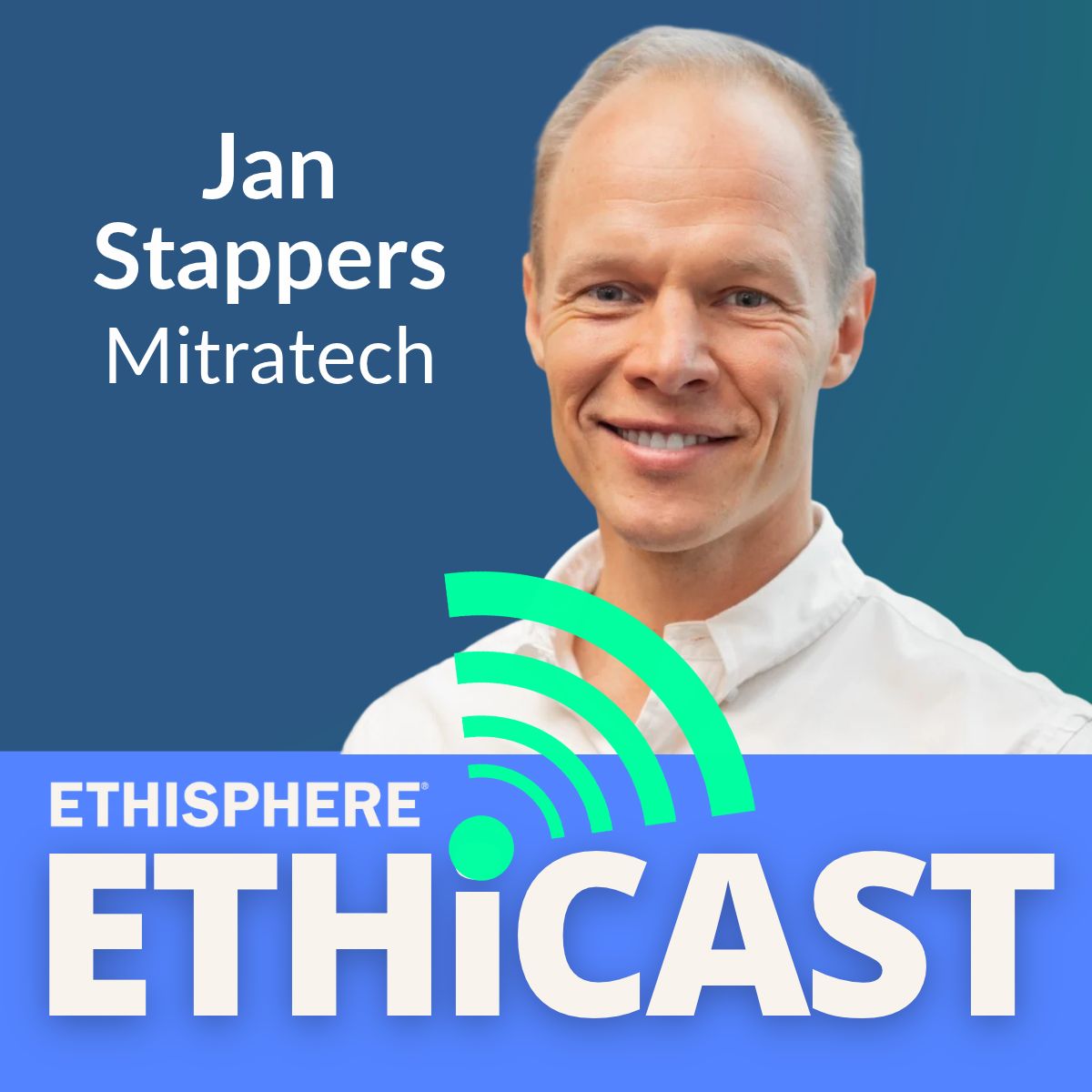
In today's episode, we'll have a virtual fireside chat with Jan Stoppers, Executive Vice President, GRC Solutions Strategy at Metra Tech, a global leader in AI powered governance, risk and compliance software trusted by more than 8,300 organizations across 75 countries.
Jan is an authority on governance compliance, whistleblowing and risk program design with deep experience in how GRC programs operate in complex real estate real world environments. He contributed to the development of ISO 37002, the international guidance for whistleblowing management systems. He is a prolific thought leader on all things ethics and compliance and I am delighted to welcome him back to the program. Jan, thank you so much for joining us. I've been looking forward to this conversation.
[00:01:09] Speaker B: Same here. Thank you so much for having us, Bill.
[00:01:12] Speaker A: Well, I'd like to begin by asking you a question about AI. 2025 was the year that a lot of ethics and compliance teams became aware of AI and built initial AI governance frameworks. 2026 was the year they started to get serious about operationalizing AI in their own programs. Jan, where do you see ethics and compliance teams in 2027 regarding their relationship to AI as an operations technology to employ, as a governance issue to manage, and as a risk to assess?
[00:01:40] Speaker B: Yeah, thanks for that question. It's actually a pretty complex question of all, but if I would look in my private crystal ball, then what appears is actually a multiple of dynamics. First of all, I hope that increasingly GRC professionals will start to realize what the best AI use cases are for their particular organization.
Section work challenges all these things because what we're seeing is that still a lot of organizations are actually trying to figure out how to how to apply AI as a serious part of their GRC work.
Having said that, I also hope that increasingly the AI frenzy, if I may call it, which means very often the push from the top to it doesn't matter how, but just use AI, don't think of the consequences. Maybe that's a nice bridge to the last topic that you mentioned on the agenda to just adopt AI governance risk compliance. We'll look into those topics later on. Just adopt it. I hope that narrative will be a little bit colored by more cases where AI went wrong because unfortunately I expect that that is still the only big stick the driver for many organizations to actually start looking into into the governance and risk related to AI and then a third one. I really expect that 2027 will bring a further maturity in AI use across organizations and that brings actually those first two points together. I really hope that more and more organizations start realizing it is a way of working of human work, it's enabler, it's not outsourcing everything to AI.
[00:03:43] Speaker A: We're seeing that boards are increasingly moving away from wanting charts, stats and tables in their updates and are instead requesting more of a story or a narrative from the person who's presenting. What do you think is driving this and how would you recommend that ethics and compliance officers take advantage of this change in preference when making their own updates to their board?
[00:04:03] Speaker B: Yeah, thanks for that question. It is indeed a topic that comes up increasingly when we exchange with customers or not yet customers, hopefully any type of organization out there. They indeed signal that boards increasingly do not want to have eight slide presentation on raw data, amounts of whistleblowing, reports coming in, turnaround times, et cetera, et cetera. Because it just doesn't tell them that much.
If I stay to the topic, if I stay with the topic of whistleblowing, the fact that you received an X amount of reports, is that good? Is that bad? You received more reports than the previous year. Again, good or bad, who knows? How do you interpret that data?
And we realized that increasingly boards, first of all, they have so much data to process, to digest that they want to have less and better data. And especially they're really asking for the context. You present me, you, their compliance manager, you present me with a certain data set. What does that mean? How should I interpret it? How should I read it? And maybe most importantly, what value either negative value can be damaged, of course, or positive value is this representing for our organization?
[00:05:31] Speaker A: This week we saw what is surely the business story of the year with the spectacular downfall of Nvidia founder and CEO Jensen Huang for his extramarital affairs with a woman that US Intelligence suspects is a Chinese spy, and with one, possibly two of his own employees.
Jan this is a board governance story. It's a values based leadership story, it's a trade compliance story, and it's a nuts and bolts ethics and compliance story. Now that we're learning that Nvidia didn't even have a dedicated chief ethics and compliance officer. So, taking into account the scale and financial effects that this has had on Nvidia and by extension the whole AI economy, where does this story most focus your attention? As an expert on ethics and compliance.
[00:06:12] Speaker B: Yeah, to be honest, I think it's almost, I mean it's tragic comic that this happens to Nvidia once, as far as I know, the most valuable company out there, if we look at market value, of course it lost a substantial part of that value. But I think so many people, especially in the US pension funds, et cetera, et cetera, have a financial interest in the well being, the value created by and through Nvidia. And it's just striking to see that every time again these kind of champions, rock stars. And I'm not just speaking of the organization, but also the people who are the face of the organization appear to not be that fantastic, that clean as you would want them to be. And then it's incredible to realize how quickly billions of market value can vaporize because of apparently wrongdoing of someone. Apparently the organization, like so many other cases that we've seen in the past, was focused on growth, on being that rockstar doing amazing things, short term, long term success, but apparently not building the fundament from the perspective of are we that risk resilient, Are we, are we that resilient regarding actual issues on the workflow, et cetera, et cetera. So I cannot say whether it's a surprise or not for me with regard to Nvidia, but I am surprised about the fact that such a big organization that's in the spotlight of so many companies, investors, people basically apparently managed to get away for so long with not having those kind of GRC checks and balances in place.
And maybe now this is the moment for those compliance people, typically still the department of know to say, you see, we told you, we warned you have this in place and you might have prevented billions of losses.
[00:08:28] Speaker A: Nvidia had an unusual management structure. Jensen Huang said he didn't understand organizational charts and didn't really believe in them. He had dozens of direct reports. He had kind of a unique management style.
It seemed like it was built for maximum efficiency, but it also looks like it was kind of open to a possibility for maximum retaliation in a whistleblowing context. So from your point of view as a whistleblowing expert, what does the structure of Nvidia and Huang's management style tell you about whistleblowing risk when it comes to holding the CEO accountable for things like potential code of conduct violations?
[00:09:04] Speaker B: Yeah, this is textbook how not to do it. Of course. First of all, the organization and himself should have realized that whistleblowers, people who and whistleblowers is often a very heavy word but people who want to report on wrongdoing, they are very valuable for you as an organization because if they don't have the chance to speak up, somehow, very often that very bad, let's say influential information will still come out, will still end up in the public domain, and then it becomes uncontrollable monster for you as an individual and the entire organization.
And that's exactly what happened. A structure where people basically have to walk through a corridor in order to hand over their whistleblowing report to the person who is involved in the, in the issue is far from ideal, with other words, very unlikely to actually work. So again, this is a textbook example of how not to do it.
If you compare with whistleblowing, best practices and even applicable laws, this is really not how to do it. And we see that it backfires.
[00:10:19] Speaker A: One of the things that I noticed, and this is again an archetypical case of when you have a leader who kind of ascends to that rockstar status, right?
That kind of creates a reality distortion field around that person. And unless they have a really strong support structure to remind them of what your values are, what your standards are, it's easy for those standards to fall away. And it can become really difficult for that person to stay, you know, where they need to be. You know, when you talked before about how this organization, you know, really could stand to use dedicated ethics and compliance function, can you talk a bit about how that function can help build the ethical infrastructure to make sure that a chief leader, no matter how much of a rock star status they get out in the market, still has the support they need within the organization to remain compliant with the law, remain compliant with your own code of conduct, remain in line with your own ethical culture?
[00:11:13] Speaker B: Well, I think this question should be preceded by a different question which is, do you actually care nowadays? Do you just care about short term profit maximalization?
Do you want just the share price to be as high as possible, no matter how many red flags are being raised about a small circle of companies that are lending to each other, et cetera, et cetera? We don't care. We just want maximum share price. Is that the thing that you care about or do you want to have long term wealth value built up? And if it's the latter, there is no other way than having also those part as a part of the fundament to put those pillars in place where there are checks and balances.
An individual cannot, in the long term run an entire organization, which is that much in the spotlight, which is that big that valuable. That is not possible. I don't believe it. At least. So you would need for the for long term wealth creation, value creation and maintenance. You need to have those checks and balances in place to make sure that you attract the right people, that you oust the wrong people with wrong who are prone to do wrongdoing or actually engaged in it. And also to show I believe that's an ethical aspect to show the world. Like yes, we are a super growth company, but we do it in the right way. I find that personally still very important.
[00:12:45] Speaker A: Well Jan, it is always a pleasure to speak with you. I learned something every single time we get together. So thank you very much for joining us on the program today and thank you very much for sharing your insights on these topics. Really enjoyed having you on the show.
[00:12:56] Speaker B: It's been a pleasure. Thanks again for having us.
[00:12:59] Speaker A: To learn more about how Metra Tech's award winning and AI powered legal, GRC and HR software can unify your team and accelerate its performance, Please visit mitratech.com and while we have you, if you're not already receiving at the Sphere's biweekly newsletter Ethisphere Insights, then please sign
[email protected] Newsletter. Each issue delivers our latest articles on demand, webinars, ENC news stories and more. That's all for now. We hope you've enjoyed the show. For new episodes each week, subscribe to us on YouTube, Spotify and Apple Podcasts. Also follow at the sphere on LinkedIn to learn more about how we help organizations like yours support make themselves more successful and more resilient by advancing business integrity. Thanks for joining us. And until next time, remember, strong ethics is good business.