[00:00:00] Speaker A: Hi everyone. In this episode we'll learn how WD's risk based approach to ethics and compliance helps it maintain its best in class program. I'm your host, Bill Coffin. Welcome to the Ethicast.
WD is one of the world's largest manufacturers of data storage devices. If you've ever owned something with a hard drive, chances are pretty good that you've owned a WD product. But aside from being a ubiquitous technology producer, WD is also an eight time World's Most Ethical Company's honoree. And we're going to talk about how the company pursues ethics, compliance and business integrity and how those efforts manage risk and build real long term value.
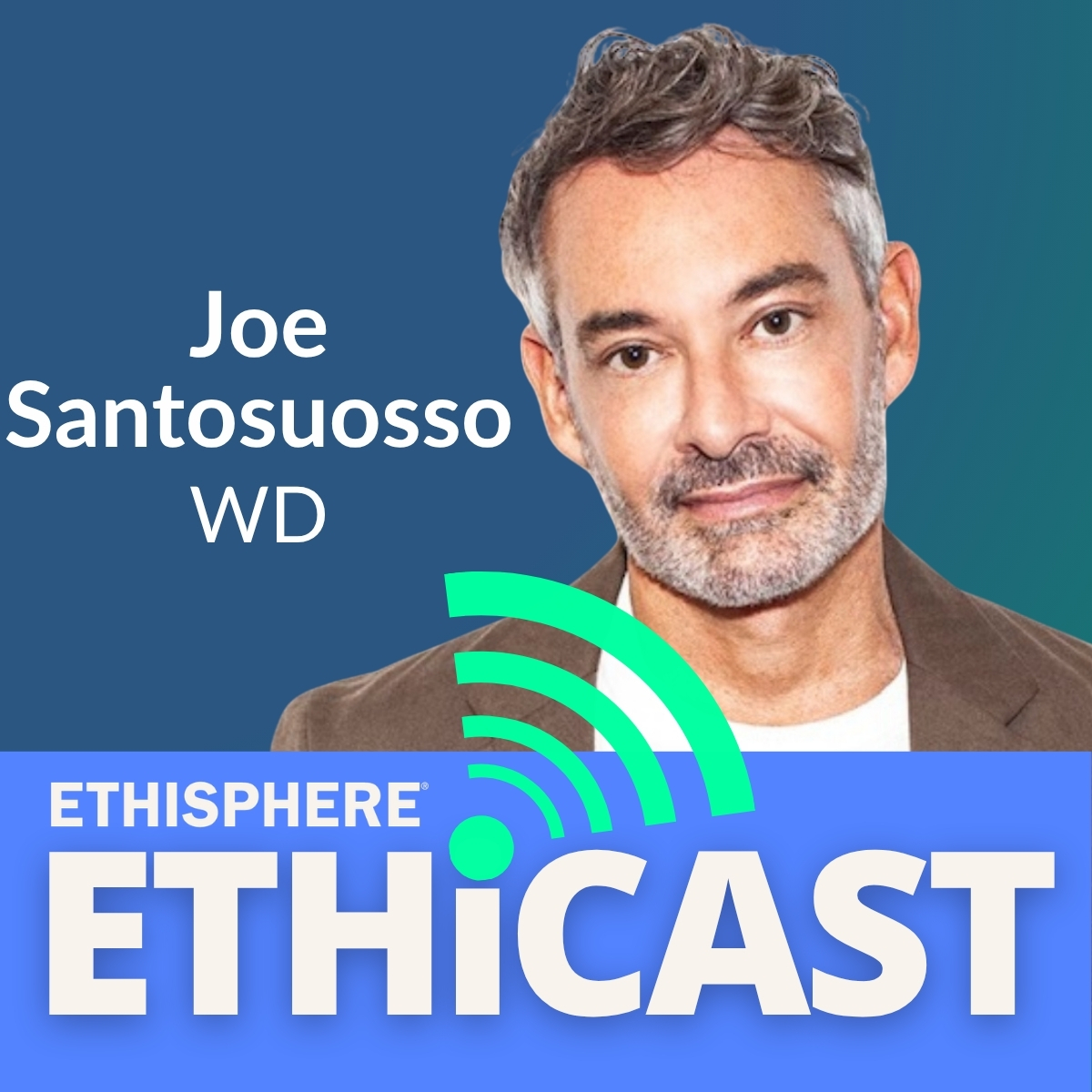
Our guest today is Joe santosuoso, Vice President Chief Compliance Officer at wd.
[00:00:53] Speaker B: Joe.
[00:00:54] Speaker A: Joe has also been a featured speaker at the Global Ethics Summit for the last two years in a row. Joe, thanks for joining us. It's really good to see you again.
[00:01:01] Speaker B: Yeah, you too, Bill. I'm a huge fan. I know we've talked about doing this several times. I'm really glad we were able to coordinate it. Thank you. Thanks for having me.
[00:01:09] Speaker A: Oh, most definitely, most definitely. I love talking about best practices. I've been following WD for a while and I've been very excited to bring you on the show. So I'm eager to get into it. So let's get started.
So, Joe, first of all, congratulations on receiving World's Most Ethical Companies honors again this year. Like I said before, WD has earned this honor a total of eight times now, as well as compliance leader verification recognition. I guess my question for you is, what do these recognitions mean to you as an E and C program and more broadly to WD as an organization?
[00:01:38] Speaker B: Yeah, you know, first of all, we're super excited and super honored. Every year, eight years in a row is huge. It's huge. Bragging rights. Right. So, you know, we have World's Most Ethical. We use that both internally and externally. And I'll talk about that in a second. But and also, you know, cld.
So the compliance leadership, one is bragging rights, the other I will say is a huge part of what we do. CLV verification gives us an opportunity to see where we stand amongst our peers. It also has given us year after year whenever we've done this, it's given us great feedback and ways to improve the program based on what we're seeing that others are doing, et cetera. So both serve different purposes, but both are really just amazing honors for us to receive. So I'm very thankful for that, you know, when you talk about World's Most Ethical, you know, internally, not only does it give us bragging rights, as I said before, and that's shouldn't necessarily be number one, but, you know, it also helps our employees. You know, it reinforces that ethics is super important to us. It's important in everything we do, every decision we make, every action that we take overall. It also, it also is a chance to give some level of accountability to our employees externally. Just as important it is, you know, independent validation to our customers, to our, you know, our suppliers, to regulators, to new employees. Here's. Here's something I would say when I say new employees. I even talking about recruiting new employees, you know, if you know this bill, I'm sure that studies show that when employees are looking to choose a company, they generally look at companies that are very public and very vocal about their stance on ethical behavior. And the World's Most Ethical is a massive.
A massive stamp for us.
[00:03:19] Speaker A: Are there any other ways in which these kinds of recognitions help you tell that story, especially to internal stakeholders, of how the work that you and your team are doing is actually making for a much stronger, more resilient, more sustainable wd?
[00:03:34] Speaker B: Yeah, you know, I think that one thing that's important to keep in mind is that these awards are not objectives, right? These are outputs of, you know, really the hard work that we do and what we show our employees. You know, the real, the real test here, the real objective is to really build our culture and to show that. Right. And I've always said, I think there's a huge difference between compliance and ethics as an example. Right. Even though they go together, I view compliance a lot, especially when you have certain regulated areas where it becomes almost a check the box, right? You have certain elements, you have to keep them.
Ethics and World's Most Ethical. And what we do really helps drive culture. You know, this is a really huge turning point in, in WD's existence, which we'll get into, I'm sure, in a bit. But I really believe that to be able to go out and tell our stakeholders, tell investors, you know, one thing I, I absolutely love is that our CEO during investor day, brags about this and talks about it to the public.
That really goes to show the importance of doing things ethically. So it's, you know, if it's not coming through to our employees through these recognitions, it's definitely coming through by the words CEO and really what it means to our investors. It's really hard to look at A return on investment. When it comes to compliance, it really is because you only know that when you're hit with some level of a violation. And so to get these recognitions and to be able to tell this to the public and to investors and to regulators, you know, it is something that we can measure ourselves. It's a good point of measurement.
[00:05:06] Speaker A: Applying for Worlds one's ethical companies and for compliance leader verification presents any program with a really rigorous benchmarking opportunity.
About a little bit more about how you measure and analyze your program, the role that external recognition programs like WME and CLV play in that, and just overall, how you make sure that your program is in a constant state of learning so it doesn't fall out of step with best practices or somehow, you know, fail to appreciate the details of your current market and regulatory environment.
[00:05:37] Speaker B: Yeah, I think benchmarking is the greatest tool that anybody in compliance has.
And if companies really believe that standing back and saying, my program's finished, then I think that's sort of a huge problem. And it's a constant change. It's constantly updating. But how do you do that? You learn from others. You learn from the best. It's not just a matter of measuring. It's also learning from the best and implementing the program, advancing it, making it better. Look, we have internal metrics that we look at.
Training numbers, use of the helpline, how many cases are coming in, how, you know, how quickly do we turn them around? What does the substantiation rate look like on allegations? That's all great. Those are traditional metrics. But there's a big piece here that is very important for us. And how do you measure culture? Right. And how do you benchmark against that? One thing we do in addition to benchmarking with our peers. I've been at roundtables with you, Bill. I talk to my peers on a regular basis. I'm a huge fan of ethisphere and the tools that I that go along with that overall. But every year when we do our code of conduct training through your help as well, we give out what's called a perception survey. The perception survey to our employees. They take that along with the training as well. This measures various pillars and it looks at what employees feel about retaliation. Are they concerned with retaliation? How often are their managers talking about the importance of doing things ethically? Do our leaders talk about it enough? Are they feeling pressure? Because we have a lot of initiatives and moving forward, how is that impacting them as well?
That perception survey is just as important to Us as the overall metrics. I think together that helps us really attain a culture that we want. I think it's super important. And here's the thing, we could have a perfect program today. The geopolitical space that we're in right now changes drastically. Regulators change or enforcement starts looking at different trends, regulations themselves change. And it also depends on the areas that fall within your world. But there are so many changes and how do you keep up with that? And you know, there are always, no matter how great your program is, there are always ways to improve it.
[00:07:49] Speaker A: Now, I understand that your program applies a risk based approach to ethics and compliance with the tacit understanding that not all risks are the same and that by prioritizing risk, your program can cover more ground with the resources, ethics that it has.
You're not the first person I've talked to that their program has a risk based approach, but they're all different. So I'd love to learn more about how you go about prioritizing risk.
[00:08:12] Speaker B: Yeah, this is really important because I will say this. All risks need to be looked at, all risks need attention. However, they're not all going to receive the same amount of attention.
And then healthy companies, I firmly believe this, I firmly believe that healthy companies take some level of risk. But it has to be an educated risk. It has to be informed in what you're doing.
And you know, we take traditional, you know, there's a traditional stance you can take. You can look at likelihood versus impact, which is a huge part of it. You know, we also work a lot with internal audit around the ERM program. But you know, you take those two factors overall, but then you need to look at what the business is doing. You know, are we moving quickly when it comes to rate, you know, to new tools, you know, AI that increases potentially risk, you know, are we looking at new markets overall? Are we going in different directions? What does leadership want to do? What decisions do, you know, business leaders need to make? So you have to take the two of those areas, right? Common everyday risk, risk measurements, likelihood, impact, and also what the business itself is going to do and what the company is going to do. And that will absolutely, hopefully inform us.
And at the end of the day, this is how I really look at this, is that you're going to take risks. There are some risks that you leave to the business and you help them make the risk. Right. I don't think our job in ethics of compliance is to resolve all risk. I think it's to help the business make healthy decisions around risk. What are risks that can easily be taken by the business?
What are risks that can be taken but with additional controls and which ones you absolutely just cannot take risk because of the violations of law. They're going to have an impact from a PR perspective.
So I do think that you have to put those in categories, and that's what ethics and compliance does. It really enables leadership to make great decisions and really have trust in the recommendations that we're giving them.
[00:10:08] Speaker A: Your organization has undergone significant transformation over the last 25 years or so. And I understand that as part of that, you've been working on a new set of organizational values that reflects the evolution of WD and where it's going. So I'd love to learn more about that and how that effort and the ethics and compliance team both inform and reflect each other.
[00:10:30] Speaker B: Yeah, that's a great question. I know you mentioned 25 years. I'm going to say this. This company is 55 years old, and having spent the majority of my career in the tech space, it's a lifetime, and it's just such an amazing experience. Now, I will tell you this. I joined this company three years ago. It's totally different company. WD is a totally different company than it was. There are significant changes to our leadership, to, you know, the culture that we have is ever expanding. But one thing that has never changed, and from what I've seen for the last 55 years, whether you want to say 25, 10, 15, what has never changed is doing things ethically in the way we do it. So I my organization, ethics and compliance, doesn't own the values. You know, those values are really driven by our chief People Officer. Katie Watson has just really been amazing. And, you know, she set the road with some significant changes to what we do. And one of her big pushes was these values. Now, it wasn't done in a silo. It was done with the input from across the company overall. But it's our job, I believe, to help implement those and really get the word out around those. So the direction that we've taken as a company overall is that we look at connection, customers, innovation, results and excellence. Right? So what I'll say by that, and I think where the implementation comes from, everything that we do is that connection overall, what that means to us, and ethics of compliance. And it creates an environment where employees feel that they have security and trust to raise issues, raise violations. They can escalate comfortably and not worry about any level of retaliation from the customer perspective. I think it shows us that trust is a huge Competitive advantage. We've seen that. We've seen that over and over again. And what we do, and that's super important to us as a company, overall innovation. It challenges us to look at new ways to do things that look at AI and look at it ethically and other tools that we're doing. That's a huge piece of what we do.
Results is super important. Results shows us that what is the function of ethics and compliance. I'm a big believer in this. Yes, there is a governance piece. I roll up to the board ultimately, and that's one of my main responsibilities. But the other is really to do so is to enable business ethically and to work with leadership and to have a stake in all of this, to have a seat at the table and really to help promote business and push it. But again, doing so ethically now, you take the final value, excellence. It wraps it all together. Right. And ethics falls within excellence. And, and I love that, absolutely. Because what it tells us is that, you know, we care as much about the way we do business is the products that we make. And, and you know, there's no such, there's no such thing as success if it's not done ethically. And this is something that's really promoted across the board in this company. It's promoted by our leadership. It's promoted by our leadership team here, the executive leadership team. And it makes it a place where I'm really happy every day to metaphorically go to work, you know, to turn on my computer, to have that level of support.
[00:13:36] Speaker A: Ethics and compliance is. It's hard work. You know this better than anybody. It's hard work.
And, you know, no matter how great your program is, you still have to make sure you sell it to your internal stakeholders. External stakeholders.
Despite all that, Joe, why is your job something that you get to do rather than something you have to do?
[00:13:55] Speaker B: Yeah, you know, I, it's, it's a great conversation to have. And, you know, you and I have had it. I've had it with my colleagues. And, you know, what drove us to this? Why are we compliance officers? Why is this so important? Right? It's. This is not for me, a have to do job. You know, I am doing something that I've, you know, I was a crossing guard in sixth grade. You know, I was always, you know, rule oriented. Right. But I think doing things ethically just sort of feels natural. And it feels like to have that level of influence feels really, really great. And I think, Bill, what I think about all the time, this never is the same Ethics and compliance is not a static field. You know, I look at what I was focusing on six months ago, which I focus on every day. Trade.
Something else to keep in mind. I will always say this to everybody who's in ethics and compliance. If you don't have trade sitting on you, please make sure you know what your trade teams are doing so that you have ideas of what that risk is. That risk can be huge as we go forward, but that's really what it was. Today it's AI, AI governance. It's not only how we use AI as an organization and what the company does, it's, you know, also what kinds of, how do we govern that? What does AI governance and data governance look like? And, you know, I spend, you know, X amount of hours a day just talking about this and, and so I can't tell you that's what it's going to be in six months or it's going to be in a year. It's constantly changing. So I am really excited about this. And you wouldn't think somebody who's been doing this for decades could still have this level of excitement and passion because it changes so often. And, you know, I don't have to do this. You know, I could have chosen, you know, I had, we all go through this sort of period of, you can call it a midlife crisis. I like to look at it as reevaluating, you know, when you have, you know, fewer days ahead of you, as you do behind you. And I thought, is this really what I want to do? And the answer absolutely was, you know, I, I, I did sit back and think about this and, you know, I don't have to do this, but I love doing it, you know, and, and you know, I couldn't imagine not having that ability to influence, that ability to really push a culture, that ability to get leadership to do the right thing and have these conversations and discussions. It's something that I absolutely love and couldn't imagine doing anything else.
[00:16:14] Speaker A: Well, I can't imagine a better note on which to end our conversation. So, Joe, I want to thank you so much for joining us and for sharing how WD does business the right way and how the world's most ethical companies recognition is part of that. Where would you recommend people go to learn more about the great work that you and your team are doing at wd and where can people go to connect with you directly?
[00:16:34] Speaker B: Yeah, I mean, you can go to wd.com from there you can see our code of conduct. Some other, you know, other things that we have done in this space as well.
You know, I know a lot of this community and you know, anybody wants to reach out, it's, you know, it's Joe Sanisuaso, it's first and last
[email protected] you can get me through LinkedIn. And listen, if there's anything that we talked about today and anybody has other great ideas, I am always open to have these conversations. And you know, I love to have these discussions with anybody who wants to. And I also look forward to seeing everybody, whether it's at the yearly conference or these roundtables that we get to do so.
I'm super grateful for this and I'm super grateful to you, Bill, for this ability, this opportunity to talk to you today and to Ethisphere. Overall, you are a great partner and a great resource for us.
[00:17:20] Speaker A: To learn more about the world's most ethical companies, visit worldsmostethicalcompanies.com where you will find links to this year's honorees and information on how you can request your application for 2027.
For a host of free resources around best practices, go to ethisphere.com and check out our Resource center. And for the latest thought leadership, blogs and feature stories, head over to our Insights section. That's all for now. We hope you've enjoyed the show. For new episodes each week, subscribe to us on YouTube, Spotify and Apple Podcasts. Also, follow Ethisphere on LinkedIn to learn more about how we help organizations like yours make themselves more successful and more resilient by advancing business integrity. Thanks for joining us. And until next time, remember, strong ethics is good business.