[00:00:00] Speaker A: Hi everyone. In this episode, we'll talk about how you can make your ethics and compliance program more practical, actionable and connected to the way your business actually runs. I'm your host, Bill Coffin, and this is the Ethicast.
Ethics and compliance programs often look strongest on paper. The policies are written, the training is assigned, the hotline is live, and the governance structure is in place. But the real test comes later, in the everyday moments when people face pressure, uncertainty, competing incentives, or a gray area that no policy can fully anticipate.
This is where culture makes the difference between a compliance program that merely exists and one that helps people understand how to apply established rules and procedures. When the business is moving quickly and and the right answer may not feel obvious, building and sustaining a true culture of ethics is shaped less by annual reminders than by what employees see, hear and experience at the workplace and from their leaders every day.
That's why your people managers play such a crucial role in reinforcing expectations, responding to concerns, escalating appropriately, and modeling ethical decision making in the flow of work. It's also why communicating your big wins is so important to tell your story within the organization.
And it's why every successful ethics compliance program learns how to position itself as a strategic investment rather than accept being pigeonholed as a cost center.
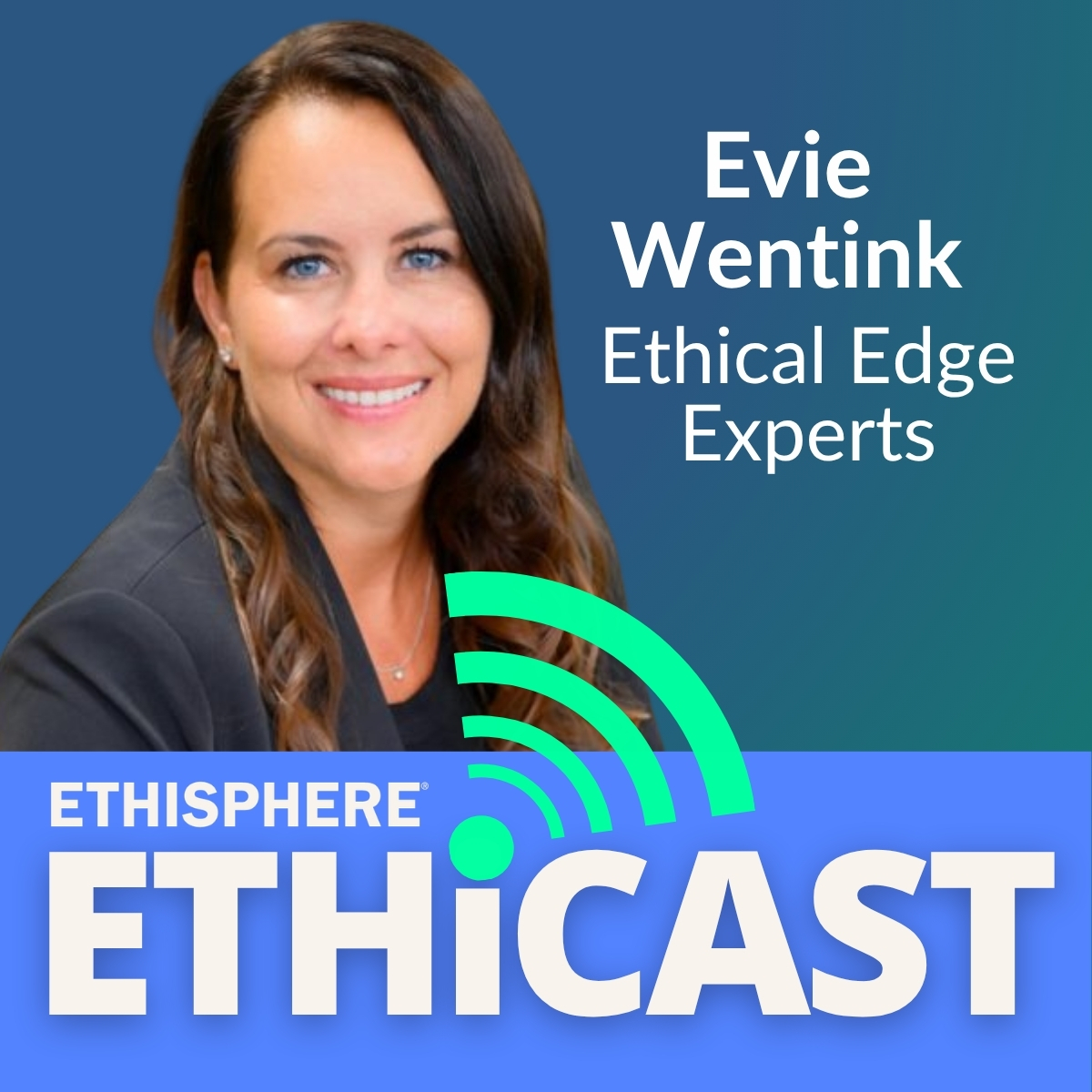
With us today to talk about all these things and more is Evie Wentink, founder of Ethical Edge Experts. Evie is a veteran compliance expert and compliance culture champion with experience building best in class ENC programs. Evie, welcome to the Ethicast. I'm delighted you could join us today.
[00:01:49] Speaker B: Thank you so much Bill for having me on. It is true pleasure to be on your episode of Ethica. So thank you.
[00:01:56] Speaker A: Well, my first question for you is about managers. Managers as we know play a crucial role in the day to day operations of any strong ethics compliance program. But they require particular support to succeed. So what are some of the best E and C practices that you've identified for organizations to incorporate into their manager training?
[00:02:14] Speaker B: Great question. So before I answer the question, I want to say there is a very good reason why managers need to talk about ethics and compliance program. Actually, not too long ago you had an Ethicast episode with Eric Jorgensen and Katie Kreuter, if you remember that one. And that got me so excited when they were talking about how the frequency of how ethics and compliance communications happen between the manager and the employees directly impact measurable perception. Like we can really see if it happens, how they speak up versus when it doesn't happen. So I thought that was really exciting. And that is almost the reason.
Well, one of the reasons why companies would want to invest in talking to or creating programs for managers to help them with these communications. Right. But in many organizations it still doesn't happen. We still don't build programs for managers. They receive annual training, probably a code of conduct training. They receive harassment prevention training, maybe it security kind of training and benefits and not really talking to them. The what, the why, the how, where and when. They should be talking to their employees on anything with ethics, compliance and integrity. So I think many companies really need to review what they're currently doing with their managers. You know, creating, I mean all of us want our managers to become the leaders of ethics and compliance and the champions of the compliance program.
But it doesn't happen without internal work so that we can have the managers understand the compliance program and talking about open door policy and talking about non retaliation and really showing the employees that you could come to us, we can create an environment for you where it's safe. Talking about psychological safety, it is safe to come with questions. But it really doesn't happen without the compliance team creating a program specific for managers to be able to do those things. And that's really part one. The part two is what Eric and Katie were talking about is teaching the managers how to talk to the employees on ethics, compliance and integrity. And it has to be an ongoing conversation.
It's not one and done. It's not an annual training. You know, the way I see it, every time you meet with employees, you create an integrity moment, ethics minute, whatever you want to call it, for the first couple minutes of your meeting and you talk about various things. You know, I see you could talk about headlines. There's plenty of great headlines. I see it every day and you can see it on my LinkedIn wall. I write about it a lot. There's so many great things to talk about to your employees and the more conversations you have, the more opportunities you create to receive feedback. And that's really, you know, why we're doing it.
[00:05:38] Speaker A: Well, speaking of conversations, communication is a key aspect of a healthy ethics compliance strategy. What recommendations do you have for how ethics and compliance leaders should pursue the communication side of what they do? And do you have any examples of efforts that you've seen that have been particularly successful in this area?
[00:05:54] Speaker B: So when it comes to communication, we need to make sure that, you know, ethics and compliance is part of the overall ethics and compliance. Communication is part of the overall organization strategy. That's a step one. Step two is making sure.
That we send the messages out that it applies to the entire organization. What I see happening a lot when I speak to companies is the message sounds like something headquarters, but it doesn't get translated to the ancillary offices, to the remote locations, satellite locations and what have you. Or even to teams that are not at their desk every day. You know, like for example, in healthcare, if you have someone who is working in the operating room, they're not receiving the messages the same way somebody does at the desktop up. And if we truly want to create meaningful communication for the entire organization, we have to account for those things. Right.
So how cross functional. It's tapping into your leaders, tapping into across various levels of organizations, various age groups is how you can create a think tank.
And what's the best way to have compliance communications for our organization?
And you know, one, when we talk about a successful story. So I would create a compliance month for an organization.
And it was EVs compliance month. It was the company's compliance month. And what we did is before it happened, we planned. So we selected various people from various areas of the organization, employment levels, from secretaries to VPs. Like it was a great mix of people.
And then we went through the structure of what we wanted to achieve. But we listened to their feedback first. How would it be received by those groups? What would they like to do? And kind of look at it from a perspective. What do they need from us in order to receive the message we want to give? And I think when you take that into an account, it really shows up in participation levels. Right. You have employees who are interested because they knew they were part of the conversation when things were being. It's not like you're trying to just give them something to check in the box, you know, like, oh, here's a survey or here is this one activity. But when we report these activities, really try to think.
In the month of compliance awareness, what kind of things would variety of people enjoy? From the giveaways, from how we selected certain things to the actual activities. We asked for a jingle, we asked for drawing, we asked for photographs. Like it was just really. Or videos. It was a variety of things that we were asking for to kind of make sure that everyone had something that they were excited about to do. Right. And then I feel now we also have to consider our young people and the way they information, Right. Like it's short videos. So maybe that's the element of doing more interviews, doing short reels. You kind of have to stay with the time to do that. You have to listen, to create your communication plan because variety of people have a lot of ideas.
[00:09:32] Speaker A: Ethics and compliance perpetually struggles to prove its value, especially when making the case for departmental resources. How should we communicate to our internal partners that ethics and compliance is a strategic investment rather than just a cost center?
[00:09:46] Speaker B: Another great question. You know, I like to use this quote to consider this. It's things will change if you just look at them differently. There is a famous Wayne Dyer quote that applies to here. And you know, ethics and compliance team need to really drive the strategic investment as opposed to cost center kind of notion with their employees. There is many, so many good reasons, you see it in the headlines every day that we understand the reason why we're here. We're here to protect the company. We're here to protect the employees, the customers, the product. There are very good reasons why we're here. And when we start looking at it as an investment rather than a cost center, our leaders should really see that it's so needed for us to be here every day.
Sometimes we forget. So having real examples and showing our value, that is tremendous.
[00:10:57] Speaker A: Despite best efforts, a lot of teams find their responsibilities growing while their resources stay fixed or even shrink. So how can ethics and compliance leaders nurture their team even when budgets get tight?
[00:11:10] Speaker B: It's important to nurture your team. And I say initially depending on the size of your team, but this shouldn't really matter.
Give praise where praise is due is important.
Compliance folks do a lot of thankless work for the organization and we talked about proving our value. Sometimes you're, you're working on these initiatives that you as a compliance person see a good reason for and you are being met with certain obstacle and hurdles. So having a good core on the inside of the team is really important because there's really good reason why we're doing it. That's one. So giving praise where praise is due, but then also inspire your team to learn more. I think there is, you know, we've always heard the notion there is so much power in learning. Learn more. Don't just concentrate on your day to day tasks at hand and reporting and you know, the compliance things that you have to do. But there's so much learning, especially now with AI, that we can do.
So as a leader, inspire your team to learn more. Inspire your team to go beyond to what they're generally doing and challenge them to do things that they're not used to. Whether it is coming on a podcast like this, whether it is, you know, everybody has a good story to tell when it comes to ethics, ethics and compliance. I talk to a lot of people different ways. So be brave, write articles, create compliance communication, or maybe lead a meeting with something new that you learned. But I think we are in a time where there is so much great information about ethics, compliance and integrity free on the Internet. You know, just look at LinkedIn. So many great resources. So you can do a lot with very little.
So challenge your team and then people also want to be rewarded. So hopefully when we combine the two, the investment and the cost, and having compliance as a strategic investment in the companies, leaders can see that there is a really good value to bring the compliance team into some of the industry events like the world's most ethical, you know, or Compliance Week or other events that happen around the year that maybe you can have a program in your company that every once in a while your star employee gets to go because budget is always an issue. So there's ways to look at things, there is ways to figure it out, how to make it work. And I think it's really important for us to take a pause and see what we're doing and how are we nurturing our teams currently and what can can we do? Because there is always an opportunity to step it up.
[00:14:03] Speaker A: Well, Evie, thank you so much for joining us and for sharing your practical guidance on how the daily work of building an ethical culture is so important. And honestly, it's easier said than done. We all know this work is not simple work. So thank you so much for your insights.
[00:14:18] Speaker B: Yes, thank you so much for having me. Really appreciated the time spending with you. And you know, I always said that if you only do in compliance the same thing you did last year, you're not doing enough. So find the little opportunities on making it better with your team, with your managers training. Right, we talked about that. And with your organization as a whole, you can always do something a little bit better. And that's how you too can be one of the world's most ethical companies. And before we started, I was showing Bill one that, you know, I do have some trophies as well.
[00:14:55] Speaker A: Outstanding. I love to see it. I love to see it. Well, again, thank you so much for coming onto the show. I hope we can, we can welcome you back again soon.
[00:15:01] Speaker B: Thank you so much. My pleasure.
[00:15:04] Speaker A: To learn more about how Evie helps organizations design and strengthen compliance programs, manage regulatory risk, and embed ethical leadership across the organization. First, follow her on LinkedIn and then visit Ethical Edge experts
[email protected] to learn more about how ethisphere can help you measure and evaluate your ethical culture, visit ethisphere.com well, that's all for now. We hope you've enjoyed the show. For new episodes each week, subscribe to us on YouTube, Spotify and Apple Podcasts. Also, follow at the sphere on LinkedIn to learn more about how we help organizations like yours make themselves more successful and resilient by advancing business integrity.
Thanks for joining us. And until next time, remember, strong ethics is good business.