Episode Transcript
[00:00:00] Speaker A: Hi everyone. Today we're going to learn about how you can better extend your compliance training efforts to non desk employees in a production environment. I'm your host, Bill Coffin and this is the Ethicast.
On March 29th, 30th and 31st, Ethisphere will host the 2026 Global Ethics Summit. Held live in Atlanta, Georgia and virtually online.
This leading ethics and compliance event brings together leaders from nearly 500 organizations around the world, representing more than 60 industries as they share innovations, insights and best practices that help them tackle the real world ethics and compliance challenges that face companies everywhere. And on March 29, we kick off this year's all killer no filler agenda with with industry Roundtables in which you can spend time with your peers discussing best practices, challenges and successes that specifically pertain to your industry.
One of these is Next Gen Exploring Emerging Tech Tools to Engage the Non Desked Employee, which will discuss the challenges of trying to apply exciting advancements in training and communications with a production workforce.
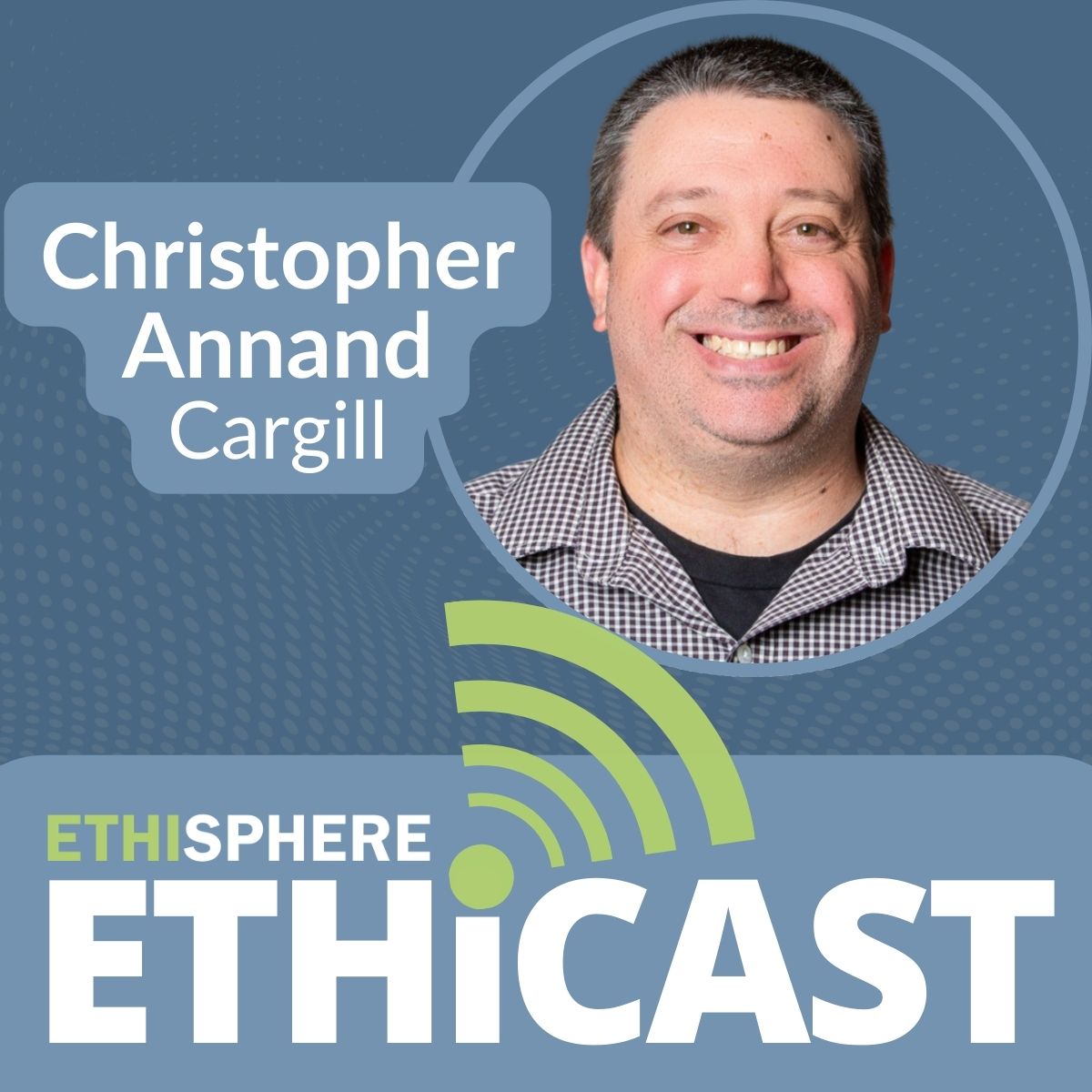
Joining us today is this workshop's leader, Christopher Anand, Senior Director of the Ethics and Compliance office at Cargill, the largest privately held US Company in terms of revenue.
Based in Minnetonka, Minnesota, Cargill's various businesses touch every major aspect of the global food supply chain, including agriculture, animal nutrition, food and beverage production, and transportation. Cargill also produces pharmaceuticals supplements, beauty products and bioindustrial products. Christopher, welcome back to the Ethicast. It's a real pleasure to have you on the show once again.
[00:01:45] Speaker B: Good morning Bill, and thanks for inviting me back. I'm really looking forward to another great conversation on what you know is a favorite topic of mine.
[00:01:53] Speaker A: Companies have worked at trying to figure out how to train employees within a production setting for a very long period of time, but nobody has really come up with the perfect solution for it. So can you talk about why that is such a persistent challenge?
[00:02:05] Speaker B: As you mentioned, Bill, and certainly from my own experience, the quest to find the most efficient means of reaching employees who work outside of your typical office or without access to company issued devices is a frequent challenge that compliance officers face, especially with companies that have a mixed workforce. And over the last past three years, the compliance team at Cargill has been looking to make more significant gains in this area, as I imagine a lot of other companies that are similar to us are doing at the same time. I'd offer two reasons why I think this effort tends to be so difficult, especially for larger sized companies where the production employee base often outsizes employees who work in a traditional office.
So first Just as there's a wide variety of roles that make up traditional office environments, there's an equally wide variety of roles in a production setting. And that variety will likely have a direct impact on your ability to get that training to them, such as whether you can attempt to provide instruction at the area where they perform their duties, or if you're needing to pull them away from their role into a shared space. And just as compliance has to be judicious in the time investment that we ask our office employees to complete training assignments online, that investment at the production level can be even heavier where the business is facing production quotas or other pressures that make them reluctant to yield large amounts of time for training activities.
Second, I also think some of the challenges that we face, to be perfectly honest or self inflicted, as your question posed, we tend to strive for the perfect solution, the magic wand that can apply a one size fits all solution to a situation where in many cases that might be close to impossible. Certainly that's kind of my impression. At Cargill, technology continues to innovate, and there are some really interesting options that can be worth exploring. But this is an effort, at least at this moment in time, where I don't feel a single solution is really the answer, especially in the pursuit, which may distract to you from some other approaches, maybe that you already have, that can provide value and possibly deliver better outcomes.
[00:04:38] Speaker A: Can you share some details of how Cargill is innovating in this area now? I'd love to hear how you're reaching your employees, especially given the company's large and diversified production workforce.
[00:04:48] Speaker B: Very happy to Bill, as an extension of the second point that I was making in the previous question, over the last couple of years I've been making a point to really look at this challenge a little differently, swapping the goal of that single uniform approach to that of a blended strategy. Now, I'll cover a few examples and then talk about why I think this approach may really resonate and have good upside with, you know, some of the listeners on the podcast today, we have portions of our production population that actually do have access to the traditional learning management system where they can access our online courses that we leverage for our office employees.
And because we move to an administration method that assigns our curriculum at one shot and then provides an extended window to complete that curriculum, the LMS is actually a perfectly good option to use for these employees. And we're working to identify other pockets of production employees where we can do the same. No reason to take a good solution and throw it out. The window if it's working. So we're going to leverage that.
However, most of our production workforce, like many other companies, is not going to have access to the lms. That's one of the challenges.
But in our smaller facilities, where we have the ability to target groups of workers, perhaps by a complete shift schedule, facilitated sessions are a perfectly good option and not so hard to do if you time them with those shift changes. And this is a space where we've seen some interesting technologies that can really enhance that experience, such as a solution called alchemy, which incorporates these handheld clickers allowing groups of employees to participate in knowledge check questions, allowing all of them to do it, and kind of getting that real time feedback of what their peers have selected, and some level of safety of not being the single employee that raises their hand and now all attention is on them and if they get it wrong, oh, you know, and that, that might prevent them from actually wanting to participate. So alchemy is an interesting, an interesting option for.
And even with facilitated sessions, there are options for who conducts the training. So you could have your compliance staff that come to the location. You could leverage a train the trainer session so that a local member of the facility can be the representative for the content.
It also provides more options when you work with a local person to find workable times for the business.
Plugging compliance material into existing standup meetings, town halls, to reinforce messaging that happens, you know, from other avenues.
What ties a blended approach together that I'm presenting some of these examples on is by putting some additional effort on the front end to understand and map out the audience that you're looking to reach. Considering what compliance risks are most relevant, what delivery methods may get the most buy in from the facility level?
Are there opportunities to take existing content from your online program and maybe streamline it into something smaller and where you can do a more targeted session that's easier for the employees to retain. And finally, remember that any training program always benefits from a complementary communication strategy. Posters, video boards tie ins with other events because it's that communication that keeps the training alive rather than that one point in time where admittedly, if you don't really Follow up after 3, 4 months, Whoop goes out the head.
So you need to reinforce it. So communication is key and communication often is very cost effective. You don't need to have so much technology to be able to do that. So I think ultimately the pursuit of a blended strategy with your production audience has more potential to drive a more lasting impact. Because of the nature of the approach where you forego a single method for a variety of tools to meet employees where they are, and you encourage input from your business partners to participate in the development of the overall program.
[00:09:16] Speaker A: So, Christopher, I've been following Cargill's program for a while, and I'm always delighted to hear about how you're innovating. But I also realized that, you know, what happens at Cargill isn't necessarily one size fit all for everybody. So I'm kind of curious, what advice do you have for ENC leaders out there who are themselves trying to devise a way to train employees who might not be at a desk or terminal, especially those in the manufacturing sector?
[00:09:37] Speaker B: Well, here's an admission. You know, I've been at Cargill for 13 years, but this is the first time in being with Cargill where I'm actually working with more of a production audience. I came from the financial services sector, all office employees, Completely different style of training, different approach.
And when I joined Cargill Gill 13 years ago, coming from that completely different world, the VP that I reported to at the time offered some very simple advice that I think really applies to this broader topic. And the question that you just posed. Now, she said that at the heart and business of Cargill, of which I was joining, that's not located at headquarters, that's not located in an office that lives in the fields and the facilities where the bulk of the production and the population works. Now, I'm going to bet for a lot of listeners on this podcast that work in companies that contain a manufacturing element, that statement will ring true just as well for their situation. And it's a really important statement to keep in mind as I kind of go to the broader part of this answer. If we transform that statement into action, I think it says this. If you really want to reach your production workforce so you can more directly target their needs, you have to go to them.
You need to talk to their leaders. You need to ask about the risks they see as most important.
Where do they feel that they have been successful with maybe other types of training? What slipped, what has been a challenge, you know, taking that knowledge and starting with a simple curriculum, maybe on just a few topics, and then iterate through feedback and your own assessment of the effectiveness of what you've done so far and accept that it will not be perfect, it's just not going to be. Perfection is actually not the goal. I would argue continuous improvement is.
So I feel that if you place that effort there, as opposed to the pursuit of that magic wand, the program that you have is going to improve much faster. You're going to have more allies to your cause and you're going to be far less frustrated. And hey, there's going to be frustration. It will be less frustration. And I think ultimately, at the end of the day, if we do see some technology that really wows the space and suddenly makes things that much easier, great, we can look at adopting it at that point. Point. But in the meantime, you're spending more time on actually improving the situation than chasing after what is that solution going to be that that solution may make itself available to us without that much effort. In the meantime, we can pursue this blended strategy that I think really does work better.
[00:12:42] Speaker A: Christopher, I love what you had to say about continuous improvement. And that's kind of inspired a follow up question I have for you. I'm sure that there are folks listening to you and they kind of wish that their organization was closer to Cargill's level of maturity area.
So do you have any words of encouragement you could pass along to those folks?
[00:12:58] Speaker B: Absolutely. Absolutely. And first, as I admitted to in the answer to just the immediate question that we were talking about, I entered an agricultural space where I had no experience at all. I had a lot of tools, I had a lot of skill, but I had to be humble as I entered that space. And I had to recognize I don't know the space well. I need to learn. And then from that learning I can start making these, these smaller improvements. So first I'll tip my cap to the host for allowing me to insert a shameless plug.
For those of you that are planning on attending the upcoming Global Ethics Summit, as was mentioned, I'm hosting this manufacturing industry roundtable on the topic we've been discussing today.
I really encourage you attending workshops like that and also making use of the broader BELA community. This is what BELA and these workshops are meant for. Compliance is not a competition. We are fellow travelers. Our organizations are unique and varied, but we face a lot of the same challenges. And strength in numbers is achieved through community. And that's exactly what Bela is. The compliance community is a powerful one.
Engage us, ask questions, and know that where there are members that seem like they're much farther ahead than you, there are other members that are going to look at you and are going to think, wow, they're much farther ahead than I am. And that's the point.
This is a best practice, sharing. We exchange ideas, we hear what works, maybe what doesn't. And ultimately, by sharing, learning, and hopefully laughing a little bit at the way compliance behavior. People need to laugh now and then.
We can be all the better for it. So absolutely, I hope people engage in this opportunity in the broader Bell community.
You will not be disappointed, you will
[00:14:57] Speaker A: only gain well Christopher, thank you once again for returning to the Ethicast. It's always delightful to speak with you and it's quite illuminating to hear about what you and your colleagues are working on at Cargill, especially around this issue of compliance training. So once again, thanks for coming back
[00:15:10] Speaker B: on the show, Bill. It has been my pleasure. I look forward to seeing you soon in Atlanta, along with hopefully some new compliance friends that I can meet there too and we can continue conversations like this one. So again, thank you very much for having me.
[00:15:24] Speaker A: Visit attendges.com to register for the Global Ethics Summit, where you can save your seat in Christopher's interactive workshop Next Gen Learning Exploring emerging Tech tools to engage the non desk employees. Space is limited and ges will be upon us before we know it, so don't delay, register and reserve your spot today. Also, Christopher's colleague Samantha McMackin will lead a pair of Programs in action sessions on March 30, so set aside some time to learn even more about Cargill's recent innovations and program successes. You will not want to miss it. And if you're already set to attend ges, the Ethicast will once again be streaming live from the event, so please stop by and say hello. Who knows, we might even invite you to join the show to see Christopher's other Ethicast episode, check out the link in this episode's show Notes where he gets even further into how Cargill is innovating in compliance training. Thanks for joining us. We hope you've enjoyed the program. For new episodes each week, be sure to subscribe to us on YouTube, Apple Podcasts and Spotify. And if you haven't already, please follow at the sphere on LinkedIn to learn more about how we help organizations measure and improve their ethics and compliance programs. Together, we can make the world a better place by advancing business integrity. That's all for now, but until next time, remember, strong ethics is good business.